
Scaling a Care Agency in the UK: A Strategic Framework for 2026
Most boutique providers believe that private-pay clients are the ultimate safety net for growth. In reality, this reliance often creates a ceiling that prevents true expansion. You've likely felt the friction. Manual admin bottlenecks. The looming anxiety of a CQC inspection whilst trying to increase capacity. It's a common plateau. The systems that served you at ten clients often fracture at fifty. Scaling a care agency UK wide requires more than ambition; it demands a clinical level of operational precision.
We understand the pressure of balancing the £12.71 National Living Wage with the need for sustainable margins. This article outlines the precise operational, regulatory, and commercial shifts required to move from a local provider to a market-leading agency. You'll discover a roadmap for winning larger tenders, implementing automated back-office systems, and building recruitment models that actually work. We'll examine the 2026 CQC Regulatory Reset and show you how to align your growth with the return to sector-specific frameworks. It's time to transition from manual chaos to synchronised, scalable success.
Key Takeaways
- Identify and eliminate the three primary administrative bottlenecks—scheduling, recruitment, and billing—by transitioning to a high-efficiency virtual back-office model.
- Navigate the "Regulatory Ceiling" by ensuring your compliance systems evolve in tandem with your expansion, maintaining a high CQC rating whilst scaling a care agency UK wide.
- Diversify revenue streams beyond private-pay clients by mastering tender writing for local authority contracts and integrating clinical services such as private Autism and ADHD assessments.
- Shift from reactive hiring to a proactive talent pipeline strategy, leveraging employer branding to secure a stable workforce in a competitive market.
- Implement a synchronised operational framework that treats compliance, technology, and commercial growth as interconnected components of a single, efficient machine.
Defining the Scaling Journey for UK Care Providers
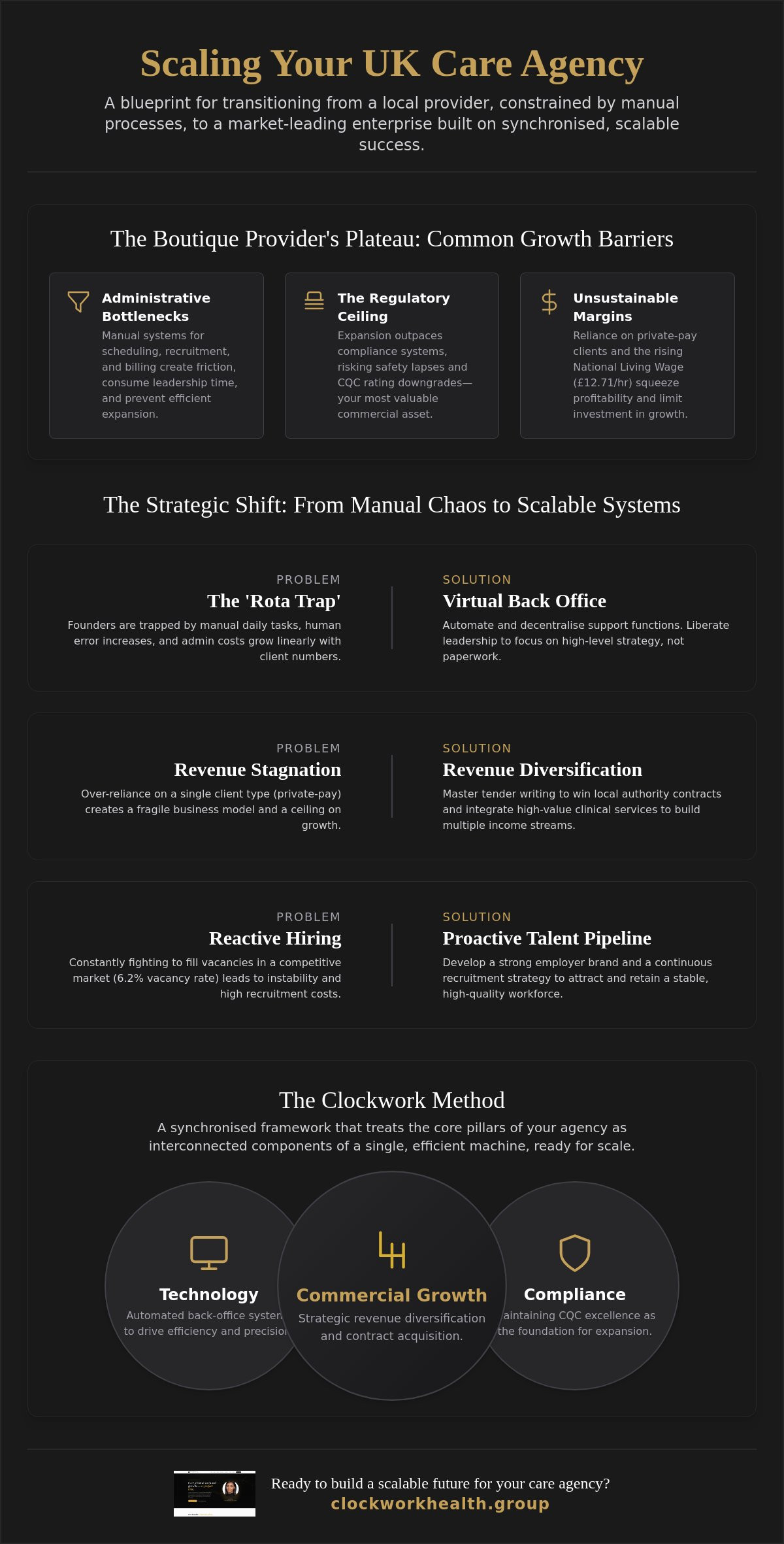
Scaling is often confused with simple growth. Growth is linear; it's the process of adding more service users and more staff in equal measure. Scaling is the strategic decoupling of revenue from operational costs. It's about increasing your capacity for care at a faster rate than you increase your overheads. In the context of scaling a care agency UK, this requires a shift from manual, founder-led oversight to a synchronised, system-driven enterprise. Without this shift, agencies hit the Regulatory Ceiling. This is the critical point where expansion outpaces your existing CQC compliance systems, leading to safety lapses and inevitable rating downgrades.
The 2026 market demands a digital-first mindset. With the National Living Wage reaching £12.71 per hour, margins are tighter than ever. Manual processes aren't just slow; they're commercially dangerous. A comprehensive UK social care system overview reveals a sector where efficiency is the only path to sustainability. Whether you're scaling a domiciliary care agency through geographic density or expanding a temporary staffing agency via high-volume recruitment, your infrastructure must be predictive rather than reactive.
The Transition from Boutique to Enterprise
Moving beyond the boutique stage requires a fundamental change in leadership. The founder can no longer be the primary decision-maker for every care plan or roster change. You must delegate authority to a middle-management tier supported by robust KPIs. These metrics must monitor both financial health and clinical outcomes simultaneously. Track your EBITDA alongside your medication error rates. In 2026, the scaling threshold is reached when a provider transitions from reactive survival to predictive, data-driven operations across multiple care branches.
Regulatory Stability as a Growth Foundation
Your CQC rating is your most valuable commercial asset. A "Good" or "Outstanding" result acts as a powerful marketing tool for both private-pay families and local authority commissioners. When you expand into new regions or service types, your foundation must be clinical excellence. It's essential to secure expert CQC registration support UK to ensure new branches meet the 2026 Regulatory Reset standards from day one. The Registered Manager's role also evolves during expansion. They must shift from being a hands-on supervisor to becoming a strategic leader who maintains clinical culture across a distributed workforce. Scaling a care agency UK is only possible when your compliance remains as steady as a clockwork mechanism whilst your footprint grows.
Optimising Operational Infrastructure: Moving Beyond Manual Admin
Manual administration is the friction point that stalls scaling a care agency UK. Founders often find themselves trapped in the "rota trap." Scheduling, recruitment, and billing represent the three primary bottlenecks. With the social care vacancy rate sitting at 6.2%, recruitment alone can consume a founder's entire week. When these tasks are handled manually, human error increases and scalability vanishes. Efficiency isn't just about speed. It's about precision. Moving to a "Virtual Back Office" model allows you to decentralise support functions. This transition ensures that as your service user count doubles, your admin costs don't follow the same trajectory.
Automation liberates the leadership team. Instead of managing daily rotas, you can focus on high-level strategy. This might involve building relationships with local authorities or aligning your internal training with the national care workforce pathway to ensure long-term staff retention. A well-structured back office acts like a silent engine. It keeps the business moving without constant manual intervention. Strategic growth becomes impossible when you're buried in paperwork; scaling a care agency UK requires a clean break from manual rotas.
Automating the Front Door: AI Receptionists and VAs
Care enquiries don't respect office hours. An AI receptionist ensures 24/7 responsiveness, capturing every lead with clinical professionality. Families in crisis don't wait for office hours. Meanwhile, medical virtual assistants (VAs) manage the heavy lifting of compliance. They handle document management and real-time auditing. This level of technical integration is the cornerstone of a modern care business operational efficiency framework. It's about creating a system that never sleeps.
Digital Transformation of Patient Trust
Generic website templates signal a lack of investment. For high-value private clients and local authority commissioners, your digital presence is your first inspection. Professional, healthcare-specific website design establishes immediate authority. It should serve as a portal, not just a brochure. By integrating diagnostic pathways, such as private ADHD or Autism assessments, you signal a sophisticated, multi-disciplinary approach. This complexity builds trust. It proves your agency is an enterprise, not just a small-scale operation. Establishing this level of credibility often starts with bespoke website development for care providers.
Strategic Revenue Diversification and Contract Acquisition
Revenue diversification is the commercial safeguard of a growing provider. Relying solely on private-pay clients offers healthy margins but often lacks the volume required for enterprise-level expansion. Conversely, local authority frameworks provide the volume but demand extreme operational efficiency to remain profitable. Scaling a care agency UK involves mastering this risk-reward profile. In 2026, the gap between the average local authority rate of £24.10 and the Homecare Association’s recommended minimum of £34.42 remains a significant challenge. Success requires a balanced portfolio where high-volume contracts provide the operational floor whilst specialist services drive the profit ceiling. Contract acquisition isn't just a sales activity; it's the primary engine for sustainable scaling.
Diversification also serves as a hedge against policy shifts. By moving into multi-disciplinary service delivery, you reduce your exposure to any single funding stream. This strategic pivot transforms your agency from a simple service provider into a complex healthcare partner. It allows you to bid for integrated care board (ICB) contracts that smaller, less sophisticated competitors simply cannot touch. Growth becomes a matter of strategic selection rather than desperate acquisition.
Winning Local Authority and NHS Tenders
The procurement landscape has evolved. Modern bids focus heavily on social value and clinical safety. You must understand the specific procurement cycle of your target borough to remain competitive. Preparing your organisation for high-stakes bids requires a methodical approach. Using a how to win local authority tenders checklist ensures you have the necessary policies and data in place before the tender portal opens. Professional tender writing services are no longer a luxury; they're a necessity for securing the five and ten-year contracts that underpin long-term stability. Precision in your bid response mirrors the precision in your care delivery.
Expanding into Specialist Clinical Pathways
Specialisation is the ultimate differentiator in a crowded market. There is currently a massive, unmet demand for private neurodevelopmental assessments across the UK. By integrating diagnostic pathways, such as private ADHD and Autism assessments, you elevate your brand authority. Utilising gold-standard tools like the ADOS-2 assessment adds clinical weight to your portfolio. This expansion doesn't just increase revenue; it attracts higher-tier clinical talent, such as Mental Health Nurses and Psychologists. Scaling a care agency UK becomes significantly easier when your brand is synonymous with specialist expertise rather than just general support. You aren't just selling hours of care; you're providing complex clinical solutions.
Building a Sustainable Workforce Strategy for Growth
Reactive hiring is the primary barrier to scaling a care agency UK. When you only recruit to fill a vacant slot, you're already behind the curve. In 2026, the adult social care sector faces a vacancy rate of 6.2%, equating to approximately 96,000 open roles on any given day. To scale effectively, you must transition to a proactive talent pipeline. This involves constant engagement with potential candidates, even when your current rosters are full. Your employer brand must communicate more than just a job; it must offer a professional pathway. Salary alone is no longer a differentiator. With the National Living Wage at £12.71, you must compete on culture, flexibility, and professional development. It's about being an employer of choice.
The strategy differs depending on your business model. If you are looking to start a temporary staffing care agency, your focus is on high-volume recruitment and rapid deployment. Scaling a domiciliary team, however, requires a focus on geographic density and long-term retention. Both models rely on reducing the "time-to-hire" metric through automated onboarding. Every day a candidate spends in the "pending" stage is a day they might be headhunted by a competitor. Automation ensures that the momentum of interest isn't lost to administrative delay.
Recruitment Automation and Compliance
Digital tools are essential for tracking DBS checks, training certificates, and right-to-work documentation. These systems provide real-time alerts for expiring credentials, ensuring your workforce remains compliant without manual auditing. Scaling your recruitment requires maintaining "fit and proper person" standards at pace. Compliance represents the most significant bottleneck in care recruitment because it requires the meticulous verification of non-negotiable safety standards before a single hour of care can be delivered. By digitising this process, you remove the friction whilst maintaining the safety of your service users.
Leadership Development amongst Registered Managers
Expansion often places an immense emotional and operational toll on frontline staff. To mitigate this, your Registered Managers must be trained to think like business unit leaders. They need to understand the commercial impact of staff turnover and the clinical value of high-quality supervision. Organising regular clinical supervision is not just a regulatory requirement; it's a retention tool. It provides the psychological safety needed for staff to perform in high-stakes environments. Scaling a care agency UK depends on a leadership tier that can synchronise clinical excellence with commercial growth. For providers navigating these complex requirements, our expert care sector consultancy ensures your compliance framework is built for scale.
The Clockwork Method: Synchronising Compliance and Growth
Achieving total operational harmony is the final stage of the scaling framework. When technology, compliance, and commercial strategy move in unison, the business operates like a precision instrument. Scaling a care agency UK requires this level of synchronisation to avoid the structural collapses that often follow rapid expansion. Compliance shouldn't be viewed as a regulatory hurdle. It is the foundation of your brand's market value. At Clockwork Health Group, we bridge the gap between clinical expertise and modern business strategy, ensuring your growth is as safe as it is profitable.
Professional mentorship is vital for care entrepreneurs navigating the 2026 landscape. The complexities of the "Regulatory Reset" and the rising National Living Wage leave little room for error. Having a steady hand to guide your strategic decisions prevents costly missteps. It's about moving from a trial-and-error approach to a methodical, architected expansion. Growth fails when the gears aren't aligned; success happens when they are synchronised. This is the difference between a business that grows and a business that scales.
Consultancy-Led Growth Strategies
External audits are essential before any major scaling push. They provide an objective view of your operational readiness. You don't want to discover a system flaw whilst managing a 50 per cent increase in service users. Leveraging professional CQC registration support allows you to launch new branches or specialist services with confidence. An "Authoritative Architect" in your corner provides the specialised knowledge required to navigate high-stakes bureaucratic landscapes. This partnership ensures your infrastructure is robust enough to support your ambition.
Next Steps for Your Scaling Journey
Your journey begins with a clinical gap analysis of your current digital and regulatory infrastructure. Identify where the manual bottlenecks remain. Set clear, data-driven 12-month scaling targets for 2026. Focus on density before geographic breadth. Before you take the next step, ensure your foundation is secure. Use this final checklist to assess your readiness:
- Infrastructure: Is your virtual back office fully operational and decoupled from founder-led management?
- Compliance: Are your CQC systems ready for a multi-branch audit under the new 2026 framework?
- Revenue: Have you secured at least one NHS or local authority framework contract to balance your private-pay portfolio?
- Workforce: Is your proactive talent pipeline generating a consistent flow of qualified candidates?
The transition from a boutique provider to a market leader is a deliberate process. It requires precision, time, and the right strategic partners. To begin your transformation, enquire about our care agency startup and scaling packages today.
Architecting Your Agency's Future
The transition from a boutique provider to an enterprise-level agency is a calculated synchronisation of technology and clinical excellence. You've seen how manual bottlenecks stall growth and how strategic revenue diversification creates a sustainable commercial floor. Success in scaling a care agency UK depends on your ability to build a proactive talent pipeline whilst maintaining a rigid focus on CQC compliance. It's about moving from founder-led chaos to a methodical, system-driven operation. The 2026 market belongs to those who build with precision.
Clockwork Health Group provides the specialised expertise needed to navigate this transition. Led by a Registered Mental Health Nurse and ADOS-2 Assessor, we offer a unique blend of clinical authority and modern business strategy. Our team provides end-to-end support, from bespoke healthcare website design and AI automation to specialist CQC registration and tender writing success. We act as the steady hand in your expansion, ensuring every component of your business works in harmony.
Scale your care agency with expert consultancy and modern tech solutions from Clockwork Health Group. Your growth doesn't have to be a compromise; it's time to build your legacy with confidence.
Frequently Asked Questions
What is the biggest challenge when scaling a care agency in the UK?
The primary obstacle is maintaining clinical safety and CQC compliance whilst increasing operational volume. As headcount grows, founders often struggle to transition from manual oversight to system-driven delegation. This friction, coupled with the national 6.2% vacancy rate, creates a "Regulatory Ceiling" where growth outpaces safety systems. Success requires synchronising your recruitment pipeline with automated back-office infrastructure to ensure quality remains consistent.
Can I scale my care agency without a CQC rating of "Good" or "Outstanding"?
Scaling effectively without a "Good" or "Outstanding" rating is nearly impossible in the current market. Local authorities and NHS frameworks typically mandate these ratings for contract eligibility. Furthermore, high-value private-pay families use CQC reports as their primary trust metric. If your rating is "Requires Improvement," your focus must remain on clinical rectification and stabilisation before attempting any significant geographic or service expansion.
How much does it cost to scale a care agency through tender acquisition?
The investment for scaling through tenders involves bid preparation, professional writing, and ensuring operational readiness for high-volume delivery. You must account for the cost of meeting "social value" requirements and upgrading digital systems to meet commissioner standards. Whilst we don't quote specific fees for our services, agencies should budget for both external consultancy and the internal resources needed to manage the transition to framework-based delivery.
Is it better to scale through private clients or local authority contracts?
A hybrid model is the most sustainable approach for scaling a care agency UK wide. Private-pay clients offer higher margins and immediate cash flow, whilst local authority contracts provide the high volume needed for enterprise-level growth. Relying on a single stream is risky. Diversifying your revenue ensures that you aren't vulnerable to local government budget cuts or shifts in consumer spending patterns.
How does an AI receptionist help a care agency grow?
An AI receptionist ensures that no care enquiry is lost, regardless of when the call arrives. Families in crisis often search for care outside of standard office hours and will move to a competitor if they reach a voicemail. By capturing leads and answering basic compliance questions instantly, the technology allows your senior team to focus on clinical assessments and strategic networking rather than basic lead administration.
What clinical qualifications do I need to offer private ADHD or Autism assessments?
You must employ or contract a multi-disciplinary team of qualified clinicians, such as Psychologists, Psychiatrists, or Specialist Nurses. These professionals must be trained in gold-standard diagnostic tools like the ADOS-2 or ADI-R. Adding these specialist pathways differentiates your agency from general providers but requires a robust clinical governance framework to maintain professional standards and ensure diagnostic accuracy across the service.
How do I maintain care quality whilst rapidly increasing my staff headcount?
Quality is maintained by digitising "fit and proper person" checks and implementing a structured clinical supervision model. Rapid hiring must not result in bypassed safety protocols. Automated systems track training expiries and DBS renewals in real-time, whilst senior staff must lead regular peer reviews. This ensures that the company's clinical standards are replicated across every new branch or team without manual oversight failure.
What is the role of a care sector business growth consultant?
A growth consultant acts as the "Authoritative Architect" by bridging the gap between healthcare regulation and commercial strategy. They provide external audits to identify operational gaps and help navigate complex CQC registration processes for new services. Their role is to ensure that your business infrastructure is synchronised for high-efficiency growth, allowing for scaling a care agency UK without compromising on clinical safety.