
How to Win Local Authority Tenders: A Definitive Care Sector Checklist
A high-quality care service is no longer enough to secure a contract. Most providers spend weeks on complex bids only to lose out to larger national competitors. If you want to know how to win local authority tenders, you must treat your bid with the same clinical precision you apply to your care delivery. It is a game of evidence. It is a game of compliance. It is a game of strategic alignment.
We understand the frustration of managing confusing social value requirements and rigid procurement thresholds. It often feels like the system is weighted against dedicated local providers. This article changes that. We provide a structured, clinical-grade roadmap to help you master the procurement process and evidence your quality effectively.
You will learn how to address the Procurement Act 2023 requirements and the 2026 CQC framework changes. We cover the specific evidence needed to meet social value weightings that now range from 10% to 30%. This is your definitive checklist for winning sustainable local contracts and scaling your business with confidence.
Key Takeaways
- Identify the critical operational differences between Framework Agreements and Dynamic Purchasing Systems (DPS) to select the most efficient procurement route.
- Treat your CQC registration and latest inspection rating as the non-negotiable foundation for all local authority bidding activity.
- Capture the vital 10% to 20% of scoring weightings by aligning your social value commitments with specific council mission targets and local priorities.
- Master how to win local authority tenders by applying the "Golden Thread" strategy and STAR methodology to produce evidence-based, high-scoring responses.
- Transition from a reactive startup model to a contract-ready provider by establishing strategic relationships with commissioners before the tender window opens.
Understanding the Local Authority Procurement Landscape for Care
Local authority tenders are competitive procurement exercises designed to secure high-quality social care services whilst ensuring value for public money. For providers, these contracts represent more than just revenue. They offer long-term stability and a structured pathway for growth. Understanding how to win local authority tenders begins with deconstructing the mechanism of the market. The UK public procurement landscape is governed by strict regulations, including the Procurement Act 2023, which mandates transparency and fairness across all commissioning activities.
The demand for care is consistent and expanding. Local government focus remains fixed on domiciliary care, supported living, and residential services. However, the methodology of purchasing has evolved. Modern commissioning has shifted towards "Outcome-Based Commissioning." This model moves away from simply buying "hours of care" and instead rewards providers who can evidence tangible improvements in a service user's quality of life. Success requires a clinical-grade approach to evidencing these outcomes during the bid stage.
Frameworks vs. DPS: Choosing Your Entry Point
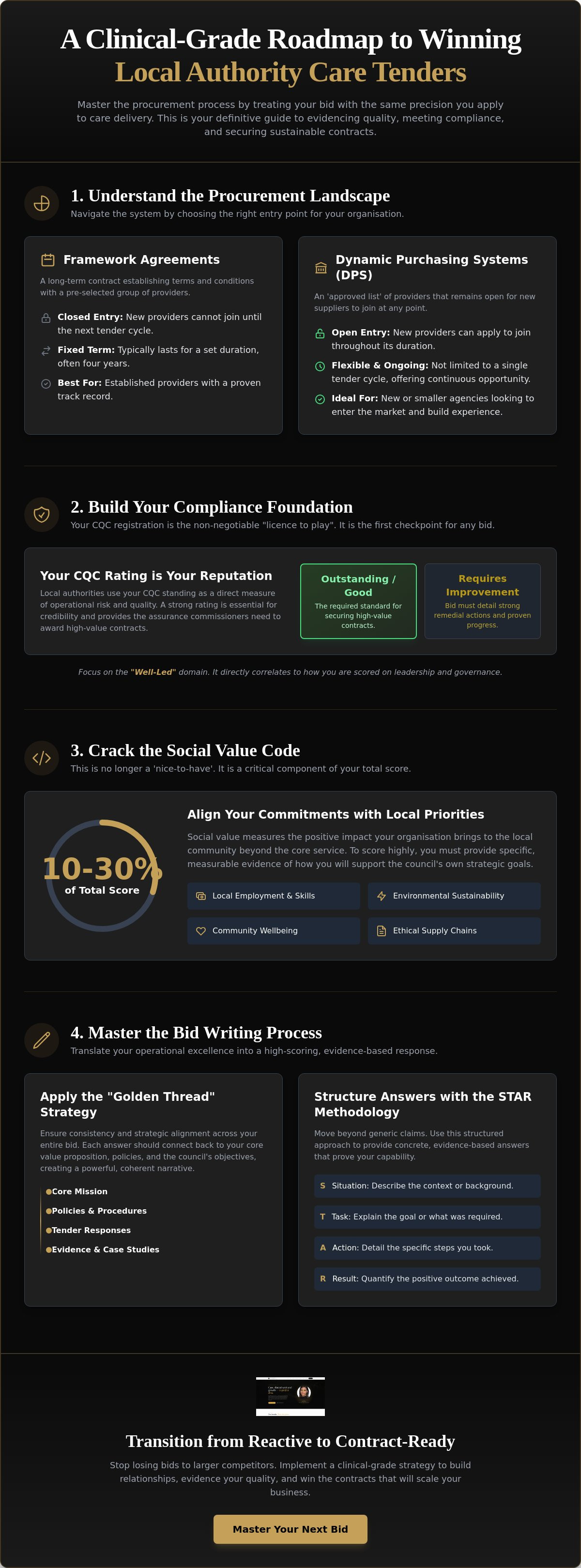
Navigating the entry points is vital for strategic scaling. A Framework Agreement is a long-term contract with one or more providers, often lasting four years. Once a framework is closed, new providers usually cannot join until the next tender cycle. In contrast, a Dynamic Purchasing System (DPS) remains open to new applicants throughout its duration. For new or smaller care agencies, a DPS is often the friendlier option. It allows you to join the "approved list" once your compliance and clinical standards are verified. Once you are on a framework or DPS, the council awards specific packages of care through a "call-off" contract mechanism. Monitoring portals like ProContract or In-Tend is essential, but you must maintain operational focus to ensure your internal systems are ready when the right opportunity appears.
The Thresholds: From Small Contracts to Find a Tender
Procurement rules change based on contract value. In the UK, local authorities must publish details of all payments over £30,000, including VAT, under requirements expected by April 2026. Smaller contracts may be awarded through simplified quotes, but larger opportunities follow more rigid paths. For health and social care, the "Light Touch Regime" (LTR) provides commissioners with more flexibility than standard goods contracts, acknowledging the personal nature of care services. As of January 2026, the threshold for sub-central government services is £207,720 inclusive of VAT. Contracts exceeding this must be advertised on the Find a Tender service. Identifying how to win local authority tenders involves matching your current capacity to these thresholds. Don't chase massive regional contracts if your current workforce cannot sustain them; start with smaller lots to build a proven track record of clinical and operational excellence.
The Compliance Foundation: CQC Standards and Regulatory Readiness
CQC registration is your entry ticket. It is the non-negotiable "licence to play" in the UK care sector. Without active registration, your bid will likely fail at the first selection stage. Local authorities use your CQC standing as a proxy for operational risk. A rating of "Good" or "Outstanding" provides the credibility required to secure high-value contracts. If your service currently sits at "Requires Improvement," your tender narrative must focus heavily on remedial actions and proven progress. Understanding these regulatory nuances is essential for anyone learning how to win local authority tenders effectively.
The "Well-Led" domain directly correlates to how you are scored on leadership and governance. Commissioners want to see that your organisation is synchronised. They look for evidence of robust auditing, clear lines of accountability, and a culture of transparency. Integrating "Fit and Proper Person" requirements into your organisational structure isn't just about compliance. It proves to the council that your leadership team is competent and trustworthy. From February 9, 2026, the CQC will reject incomplete registration applications without assessment. This means your initial setup must be flawless to even enter the market.
Evidencing the Single Assessment Framework
Mapping your CQC evidence to tender questions is a strategic necessity. The CQC is replacing the Single Assessment Framework with four sector-specific frameworks by the end of 2026. You must be prepared to translate these new "Quality Statements" into persuasive bid narratives. Don't just state that you are safe. Evidence it with data. Show how your internal audits lead to service improvements. This level of precision is exactly what we provide through our CQC registration support. We ensure your regulatory foundation is bid-ready before you ever download a tender document.
Safeguarding and Clinical Governance
Winning bids describe safeguarding as a proactive behaviour, not just a static policy. Councils want to see how your staff recognise and report concerns in real-time. Your response should highlight the role of the Registered Manager in providing clinical oversight. Mentioning how you manage "Near Misses" is a powerful way to prove operational safety. It shows you learn from mistakes. It demonstrates a sophisticated approach to risk management. This clinical-grade detail is a key factor in how to win local authority tenders. If you are struggling to align your clinical standards with business growth, exploring professional tender writing services can help bridge that gap.
Cracking the Social Value Code in Health and Social Care
Social Value is no longer a peripheral "nice to have" in procurement. Under the Public Services (Social Value) Act 2012, local authorities are legally mandated to consider how their spending improves local economic, social, and environmental well-being. In the care sector, this often accounts for 10% to 20% of the total tender score. In certain regions, this weighting can reach as high as 30%. If you are researching how to win local authority tenders, you must move beyond vague mission statements. Commissioners now demand quantifiable commitments that align with their specific corporate priorities.
The shift from qualitative stories to quantitative data is absolute. A promise to "support the local community" carries zero weight without a measurable target. You need a structured framework to capture and report your impact. This transforms your bid from a standard service proposal into a strategic partnership. It shows you understand the council's broader goals beyond the immediate care package. Councils are under immense financial pressure. They are prioritising providers who can demonstrate a "multiplier effect" where every pound spent on care also generates local economic growth.
The Four Pillars of Care-Specific Social Value
- Economic: Focus on local resilience. Commit to hiring a specific percentage of new staff from within the local authority's postcodes. Use local SMEs for your stationery, PPE, or maintenance needs to keep wealth within the borough.
- Social: Address systemic issues like loneliness. Detail how your staff facilitate community engagement sessions or coffee mornings that go beyond the basic care plan requirements.
- Environmental: Minimise your carbon footprint. Evidence how you optimise staff travel routes using digital scheduling tools or transition to electric vehicles for domiciliary care visits.
- Health: Demonstrate clinical value. Show how your proactive monitoring and early intervention strategies reduce the burden on local A&E departments and primary care services.
Quantifying Your Impact: Moving Beyond Words
To secure high marks, you must attach a monetary or numerical figure to your impact. Many successful providers now use "Proxy Values" to calculate the fiscal benefit of their social initiatives. For example, helping a service user re-engage with community groups has a specific economic value to the council in reduced mental health spend. Creating a Social Value dashboard allows you to track these commitments in real-time, providing the clinical-grade evidence commissioners crave. This data-led approach is a cornerstone of how to win local authority tenders in a competitive market. Your agency must support the local Integrated Care System (ICS) by aligning your service delivery with regional health priorities to ensure seamless, multidisciplinary care transitions that prevent hospital readmissions.
Master the Bid Writing Process: Evidence, Methodology, and Efficiency
Winning a contract requires more than just clinical excellence. It requires the ability to articulate that excellence within a rigid procurement framework. If you are focused on how to win local authority tenders, you must adopt the "Golden Thread" approach. This means every response must explicitly link your operational delivery back to the council’s specific corporate priorities. If the council prioritises "independent living," your methodology for domiciliary care must mirror that exact language. It is a game of alignment.
Structure your evidence using the STAR method: Situation, Task, Action, and Result. This ensures your answers are logical and data-driven. Before you even start writing, use a "Bid/No-Bid" checklist. Assess the contract value against your current capacity and the required clinical standards. Don't waste weeks on a bid that doesn't align with your strategic growth. When handling the pricing schedule, be realistic. Low-balling to win a contract often compromises clinical safety and long-term sustainability. Councils are increasingly wary of "suicide bidding" that risks service failure and reputational damage.
The Winning Writing Formula
Clarity is your greatest asset. Avoid unnecessary jargon. Use the council’s own vocabulary found in the service specification. This shows you have read the requirements and understand their local challenges. Use case studies to prove your methodology works in practice. A winning claim follows the "Rule of Three." Back every assertion with a statistic, a testimonial quote, or a specific internal policy. This creates a clinical-grade level of proof that scorers cannot ignore. It transforms a narrative into a verified fact.
Operational Efficiency as a Differentiator
Modern procurement rewards innovation. Evidencing "Digital Transformation" through AI receptionists and smart scheduling proves you are ahead of the curve. It suggests a level of operational harmony that manual systems cannot match. Using virtual assistants allows your Registered Manager to move away from administrative tasks and focus on quality and compliance. This back-office strength is a major differentiator. It proves you have the infrastructure to handle rapid contract growth without service degradation. This is particularly vital given new requirements under the Procurement Act 2023, which mandate transparency for payments over £30,000. For expert support in refining your approach, our tender writing services ensure your bid is both compliant and commercially competitive.
Scaling Your Care Agency Through Strategic Contract Acquisition
Transitioning from a "Startup" mindset to a "Contract-Ready" provider is a fundamental shift in operational philosophy. You are no longer just delivering care. You are becoming a strategic partner to the local authority. This requires a move from reactive management to proactive strategy. Building relationships with commissioners before the tender goes live is essential. Attend provider forums. Engage with market engagement events. This intelligence gives you a competitive edge when the specification is finally released. It allows you to understand the specific local pressures that a standard tender document might not explicitly state.
If you are still learning how to win local authority tenders, start with smaller "Spot Purchase" contracts. These individual care packages allow you to build a verifiable track record with the council without the high stakes of a full framework commitment. They act as a clinical pilot for your service. Success here provides the essential case studies and data points needed for larger bids. To accelerate this progression, many successful agencies utilise professional tender writing services. This ensures your clinical expertise is translated into the high-scoring business language required for sustainable, long-term growth.
Post-Tender Analysis: Learning from Success and Failure
Winning is just the beginning. Failing is an opportunity for refinement. Always request detailed feedback, regardless of the outcome. Review the scoring rationales for every question. If you scored a 3/5 on safeguarding but a 5/5 on staffing, conduct a rigorous "Gap Analysis" on the lower-scoring section. Was the evidence missing? Was the methodology unclear? This methodical approach ensures your next submission is stronger. It turns the procurement process into a repeatable, improving system. It removes the guesswork from how to win local authority tenders and replaces it with data-led precision.
The Clockwork Growth Strategy
Growth requires total operational harmony. You must synchronise your CQC compliance, digital tools, and bid writing into a single, efficient machine. In a crowded care market, "Precision" is the key differentiator. It is the difference between a failed bid and a multi-year contract. Every component of your business must work in rhythm to prove you are a low-risk, high-quality provider. Do not leave your business future to chance. Book a strategic consultation to audit your bid readiness and master the complex world of local government procurement with a clinical-grade approach.
Secure Your Future Through Strategic Procurement
Securing a position on a local authority framework is the most effective way to ensure the long-term viability of your care agency. We have explored the importance of outcome-based commissioning and the clinical precision required to navigate the 2026 CQC framework changes. Mastery of how to win local authority tenders involves more than just operational competence. It requires a total synchronisation of your back-office efficiency with your frontline care delivery.
Clockwork Health Group was founded by a registered Mental Health Nurse to provide a bridge between complex healthcare regulation and strategic business growth. Our expertise in clinical assessments and CQC compliance is augmented by modern solutions, including AI receptionists and virtual assistants. This multidisciplinary approach ensures your organisation is perceived as a low-risk, high-quality partner by every local commissioner.
Master your next bid with Clockwork Health Group’s professional tender writing services. Your agency provides vital support to the community. By adopting a clinical-grade approach to procurement, you can secure the sustainable contracts needed to scale your impact and lead the UK care sector.
Frequently Asked Questions
Do I need to be CQC-registered to bid for local authority tenders?
Yes, you must be CQC-registered for almost all regulated social care tenders. Local authorities view registration as a baseline for safety and quality. From February 9, 2026, the CQC will reject incomplete registration applications without assessment. This means your regulatory foundation must be flawless before you even consider applying for a formal contract.
What is the most common reason for losing a social care tender?
The most common reason for losing is a failure to provide specific, quantifiable evidence. Many providers use generic statements rather than data-led results. To understand how to win local authority tenders, you must move beyond "we provide good care" and instead prove it with statistics, audit results, and clinical case studies.
How much weight is given to price versus quality in care tenders?
Most care tenders weigh quality higher than price, often at a 70/30 or 60/40 ratio. Quality scores now include social value, which can account for up to 30% of the total marks in some regions. Councils prioritising sustainable care models will often penalise "suicide bidding" that risks service failure or reputational damage.
Can a new care agency win a local authority contract without a track record?
New agencies can win contracts by starting with Dynamic Purchasing Systems (DPS) or spot purchase agreements. These routes allow you to build a verifiable track record without the high entry barriers of a major framework. The 2026 regulations also allow councils to reserve below-threshold contracts specifically for local UK-based SMEs.
What is the "Find a Tender" service and do I need to use it?
Find a Tender is the official UK portal for high-value public contracts over the £207,720 threshold. You need to use it to identify large regional and national opportunities. For smaller contracts over £30,000, you should monitor the Contracts Finder service and specific local authority procurement portals.
How do I calculate social value for a care tender?
Calculate social value by assigning monetary "proxy values" to your community initiatives, such as local hiring or staff volunteering. Use a recognised framework to track these outcomes against the council's specific corporate priorities. This data-led approach is a critical part of how to win local authority tenders in a competitive market.
What documents should I have ready before a tender is published?
You should have your latest audited accounts, insurance certificates, safeguarding policies, and business continuity plans ready for immediate submission. Ensure your CQC "Well-Led" evidence and staff training logs are up to date. Maintaining a "bid library" of these documents ensures you don't miss short tender deadlines due to administrative delays.
Is it worth hiring a professional tender writer for my care agency?
Hiring a professional writer is often essential for translating clinical expertise into the high-scoring business narratives that commissioners expect. A specialist ensures your methodology aligns with the council's strategic goals whilst protecting your management team's time. This investment significantly increases your probability of securing a sustainable, multi-year contract.