
CQC Registration Support UK: A Strategic Guide for Care Providers 2026
Did you know that as of February 2026, the CQC now routinely rejects incomplete or inaccurate registration applications at the point of receipt without progressing them to a full assessment? For many care providers, this regulatory shift transforms a complex administrative task into a high-stakes barrier to entry. If you're feeling the weight of the new sector-specific assessment frameworks or the fear of a non-refundable £1,522 application fee going to waste, you aren't alone. Securing professional CQC registration support UK is the most efficient way to navigate this rigid landscape and protect your investment.
It's frustrating to see your business goals stalled by bureaucratic red tape and the constant evolution of professional standards. This guide provides the strategic blueprint you need to master the registration process and secure your provider status with absolute confidence. We'll show you how to build a clinical governance framework that doesn't just satisfy regulators; it positions your brand to win lucrative local authority tenders. We'll explore the path from initial application to operational excellence, ensuring your care business is ready to scale from day one.
Key Takeaways
- Understand the legal requirements under the Health and Social Care Act 2008 and define your regulated activities precisely to avoid immediate rejection.
- Use professional CQC registration support UK to turn your Statement of Purpose into a strategic operational blueprint that satisfies rigorous financial and clinical scrutiny.
- Prepare for the enhanced Registered Manager interview by mastering practical demonstrations of leadership, governance, and the Fit and Proper Person Test.
- Avoid the pitfalls of generic policy templates by identifying common causes of application failure, such as inconsistent data and insufficient clinical detail.
- Build a scalable foundation for your care business by integrating modern infrastructure, including AI receptionists and virtual assistants, from the very beginning.
Navigating the Complexity of CQC Registration in 2026
The Care Quality Commission (CQC) serves as the independent regulator of health and social care in England. For any new provider, registration is the mandatory legal gateway established under the Health and Social Care Act 2008. It's a binary requirement. You're either registered or you're operating illegally. This isn't a box-ticking exercise. It's a rigorous test of your operational viability and clinical safety.
The scope of regulated activities is broad. It encompasses everything from personal care in domiciliary settings to specialist clinical services and mental health support. If your business model involves a regulated activity, you must secure your status before seeing a single service user. Failing to do so carries the risk of criminal prosecution. There's no middle ground here. Precision is required from the first draft of your application.
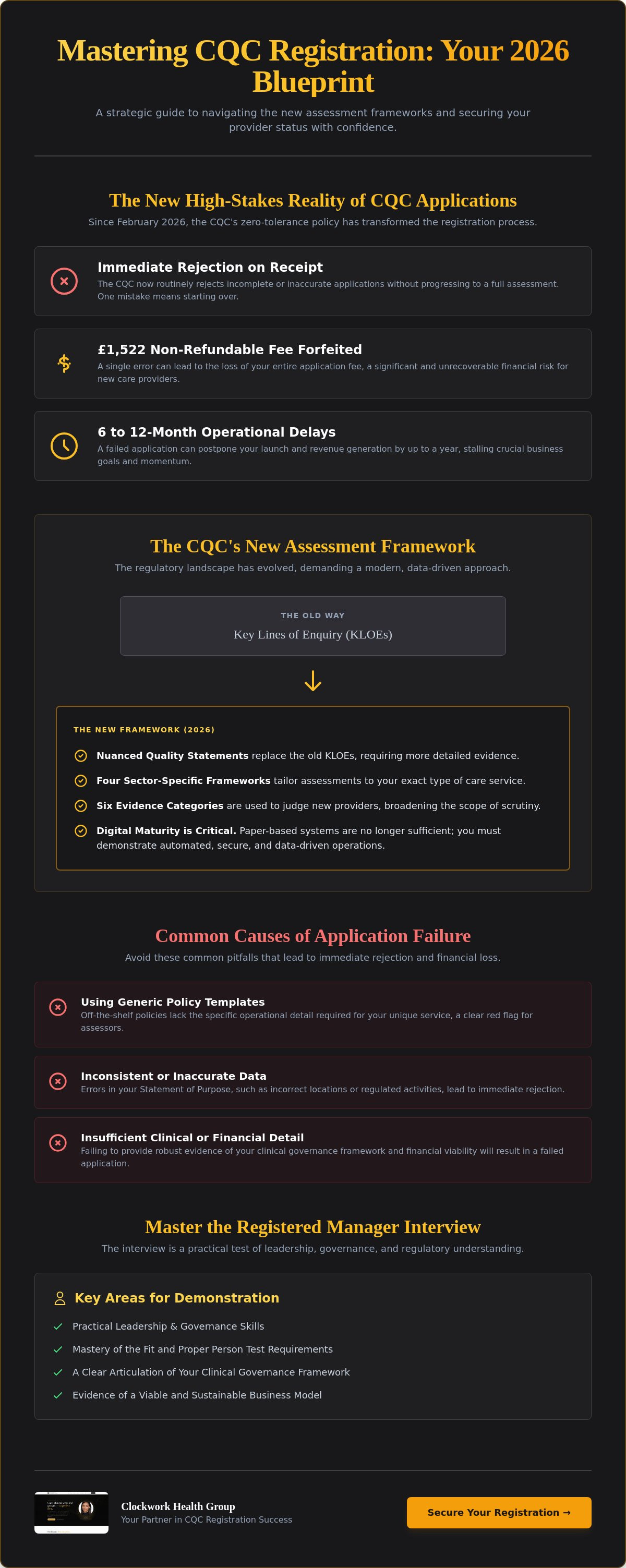
The stakes are exceptionally high in 2026. Since 9 February 2026, the CQC has implemented a zero-tolerance policy for incomplete applications. They now routinely return or reject inaccurate submissions at the point of receipt. A single error can delay your revenue stream by 6 to 12 months and forfeit your £1,522 application fee. This is why professional CQC registration support UK is no longer a luxury. It's a strategic necessity. We adopt the Authoritative Architect approach. We don't just help you pass; we build compliance into your business DNA.
The Health and Social Care Act 2008: Legal Requirements
Under the 2008 Act, registration is required for both the legal entity, known as the provider, and the individual responsible for day-to-day operations, the Registered Manager. Startups must also manage statutory notification requirements. These notifications are legal obligations to inform the CQC about specific events or changes within the service. Failure to register correctly is a criminal offence. It's that simple. Precision at this stage prevents future legal entanglements and protects your reputation before you even launch.
The Shift to the CQC New Assessment Framework
The regulatory landscape has shifted. The old Key Lines of Enquiry (KLOEs) have been replaced by a more nuanced system of Quality Statements. By the end of 2026, the CQC will have transitioned fully to four sector-specific assessment frameworks. These frameworks rely on six Evidence Categories to judge new providers. Digital maturity is now a critical criterion. You must demonstrate that your systems are automated, secure, and capable of providing real-time data. A paper-based approach is no longer sufficient for a modern healthcare business. Our CQC registration support UK bridges the gap between traditional care and digital-first operations.
The Core Pillars of a Successful CQC Application
A successful application is built on more than optimism. It requires a structured, evidence-based approach that aligns with the CQC's five key questions. These questions, asking if your service is safe, effective, caring, responsive, and well-led, remain the bedrock of regulation. In the 2026 landscape, the CQC expects these standards to be integrated into every facet of your operation. This is why CQC registration support UK focuses on creating a cohesive system rather than isolated documents. It's about demonstrating that your business is a synchronized machine from the very first day.
Financial viability is a critical hurdle. The CQC scrutinises your business plan and funding sources to ensure you can sustain high-quality care. They look for resilience. If your financial foundations are shaky, your application will fail. This scrutiny protects service users from the risks associated with provider insolvency. It also ensures that the £1,522 application fee isn't wasted on a venture that lacks the capital to meet Fit and Proper Person Test requirements for leadership and stability. Clinical governance must also be evidenced, showing exactly how you will monitor, audit, and improve the quality of care you provide.
Crafting a Robust Statement of Purpose
Your Statement of Purpose (SoP) is your operational blueprint. It must accurately list every location and regulated activity you intend to provide. Errors here lead to immediate rejection. Be precise about your service user bands. Over-promising on the complexity of care you can deliver is a common pitfall. Instead, align your care philosophy with the "Caring" and "Responsive" standards by demonstrating how you will meet individual needs through tailored support plans. If you need help refining this vision, our experts provide comprehensive CQC registration support to ensure your SoP is airtight.
Evidence-Based Policies and Procedures
Generic policy packs are a liability. While a £200 template might seem cost-effective, it often leads to "request for further information" (RFI) delays that can stall your launch for months. The CQC requires bespoke policies for safeguarding, mental capacity, and the duty of candour. These documents must reflect your specific staffing structure and local authority protocols. To be effective, policies must be lived by your staff through daily practice rather than simply being filed in a digital folder. This level of detail demonstrates the "Well-led" criteria that modern inspectors demand. Precise, actionable policies are the difference between a rejected application and a business ready to scale.
Strategic Support vs. Generic Templates: Why Applications Fail
Cheap policy templates are a trap. Many providers ask if they can manage the registration process using a £200 document pack found online. The answer is technically yes, but the risk is immense. Generic templates provide a skeleton without the muscle. They lack the bespoke operational detail the CQC demands in 2026. Inconsistent data is a primary reason for rejection. If your staffing ratios don't match your service user bands, the application fails. Professional CQC registration support UK ensures every component of your business works in harmony.
Clinical authority cannot be bought in a zip file. Having an ADOS-2 assessor or a Registered Mental Health Nurse (RMN) involved in your application adds a layer of credibility that a generic consultant cannot match. It signals to the CQC that your leadership possesses deep, specialised knowledge. This isn't just about passing a test. It's about building a foundation for future tender success. Local authorities look for providers with robust clinical governance already in place from day one. They want to see that your business is built for safety and growth.
The Hidden Costs of DIY Registration
A failed application is expensive. You lose the non-refundable £1,522 fee immediately. However, the true cost lies in the lost revenue. Re-applying can take another 6 to 12 months. During this time, your overheads continue but your income is zero. You also risk the "request for information" loop. This is a bureaucratic trap where the CQC asks for clarification, you provide it, and they find another issue. It's a cycle that drains your time and energy. Reputational damage is another factor. A failed Fit and Proper Person test is a significant stain on a professional record that is difficult to erase.
Professional CQC Consultancy: The Clockwork Advantage
Our approach is nurse-led and clinically driven. We leverage our ADOS-2 and RMN expertise to build bespoke governance frameworks. We don't use templates; we use a structured problem-solution format. This ensures your policies address the specific risks of your service. We also integrate modern technology from the start. Using AI receptionists or virtual assistants isn't just about efficiency. It's about demonstrating the digital maturity the CQC now expects. By choosing professional CQC registration support UK, you're investing in a business that is ready to win contracts and scale rapidly. We synchronize your clinical expertise with entrepreneurial growth.
Master the Registered Manager Interview and Fit and Proper Person Test
The Registered Manager interview is the final, most critical gatekeeper in the registration process. It is a structured competence assessment designed to probe the depths of your clinical and managerial expertise. In 2026, this interview has evolved into a rigorous examination of your ability to lead under the new sector-specific frameworks. You aren't just reciting policies. You are proving that you can operationalise them in high-pressure scenarios. Professional CQC registration support UK helps you transition from theoretical knowledge to authoritative, real-world application.
Directors and managers must also satisfy the Fit and Proper Person requirement. This legal standard ensures that those in control of care services possess the necessary character, health, and qualifications to safeguard service users. The CQC scrutinises your professional history, financial integrity, and even your psychological readiness to handle the responsibilities of the role. Articulating your "Well-led" strategy under pressure is essential. It requires a calm, methodical delivery that connects your clinical governance framework to positive service user outcomes.
Predicting CQC Interview Questions
Inspectors frequently use scenario-based questions to test your practical judgment. You should expect detailed probes into safeguarding protocols and the application of the "Duty of Candour." They will ask exactly how you handle a suspected case of abuse or a clinical error. Knowledge of the Mental Capacity Act 2005 is non-negotiable. You must explain how you assess capacity and when to apply for Deprivation of Liberty Safeguards (DoLS). The Well-led pillar is the practical demonstration of a leader's ability to implement robust governance systems that ensure patient safety whilst driving a culture of transparency and clinical excellence. Preparing an evidence portfolio with mock interview practice is the most effective way to ensure your responses are precise and compliant.
Evidencing Competence and Character
During the interview, whether virtual or in-person, you must have your evidence at your fingertips. This includes your training matrix, audit schedules, and business continuity plans. Inspectors will look for evidence of "Regulation 17: Good Governance." They want to see the systems you use to monitor quality and mitigate risk. Don't just describe your systems; show them. Use your digital portal to demonstrate real-time data tracking and incident reporting. Tips for staying calm include referencing specific regulations by name and taking a moment to structure your thoughts before speaking. This projects an image of an "Authoritative Architect" who is in total control of their operation. To ensure your leadership team is fully prepared for this high-stakes assessment, book your professional CQC registration support today.
Beyond Registration: Scaling Your Care Business with Modern Infrastructure
Receiving your certificate is a major milestone. It isn't the finish line. Registration is simply the legal permit to begin your journey. To scale effectively in 2026, you must pivot from compliance-seeking to operational excellence. This means preparing for your first inspection from day one. You need a system that functions like clockwork. Strategic CQC registration support UK provides the initial blueprint. Modern infrastructure sustains the growth. Building a digital-first care brand is essential. It attracts high-calibre staff and reassures families of your precision. You're building a legacy, not just a service.
Operational efficiency is the engine of a profitable care agency. High vacancy rates, which remained at 7.0% in 2024/25, mean you can't afford to waste human resources on manual admin. You must automate. Integrating technology into your governance framework proves to the CQC that you're well-led and responsive. It shows you value precision. It shows you value time. A business that relies on paper is a business that's already behind the curve. We help you synchronise your clinical obligations with modern entrepreneurial strategies.
Automating Compliance with AI and Tech
AI receptionists are a game-changer for new providers. They ensure you never miss a referral or a critical call from an inspector. Reliability is built-in. Virtual assistants can manage the heavy lifting of administrative compliance. They maintain your training matrix and staff files with clinical accuracy. This allows your Registered Manager to focus on care quality rather than spreadsheets. Custom care sector website design further solidifies this professional image. It builds immediate trust with local authority commissioners. They scrutinise your digital presence before awarding contracts. A polished, functional website is your digital storefront.
Strategic Growth through Tender Writing
There's a direct correlation between a robust CQC application and tender success. The evidence you gather for CQC registration support UK forms the core of your future bids. Local authorities look for the same pillars of safety and leadership that the CQC demands. If your initial registration was built on generic templates, your tender bids will likely fail for the same lack of detail. Our tender writing services leverage your existing compliance data to create high-scoring submissions. We turn your regulatory status into a competitive advantage. Ready to launch? Explore our CQC Registration and Startup Packages and build a business designed for the future.
Architecting Your Future in Care
Success in the 2026 regulatory landscape requires more than just compliance. It demands a sophisticated integration of clinical precision and modern business strategy. You've seen how the CQC's new sector-specific frameworks and stricter rejection policies have raised the bar for entry. By prioritising a bespoke Statement of Purpose and a robust governance framework, you protect your investment and eliminate the risk of costly re-application delays. The Registered Manager interview is your final hurdle. It is where clinical competence meets leadership authority.
Choosing professional CQC registration support UK transforms this complex process into a launchpad for your brand. Our nurse-led clinical expertise and ADOS-2 certified assessors provide the authoritative edge you need to satisfy inspectors. We specialise in care agency startups and tender writing; this ensures your business is ready to win local authority contracts from day one. Secure your CQC registration with our expert consultancy packages today. Your vision for a high-quality care service is within reach. Let's build it with precision and purpose.
Frequently Asked Questions
How long does the CQC registration process typically take in 2026?
The CQC typically aims to process a registration within 10 to 14 weeks once the application is validated. However, the preparation phase often takes several months to ensure all policies and governance structures meet 2026 standards. The CQC is currently focused on clearing backlogs, with a target to complete 9,000 assessments by the end of September 2026. Delays often occur if the inspector requires additional clarification during the validation stage.
What are the most common reasons for a CQC application being rejected?
Since 9 February 2026, the most frequent reason for rejection is an incomplete or inaccurate application form. The CQC now returns these immediately without a full assessment. Other common pitfalls include inconsistent data between your Statement of Purpose and staffing levels, or a lack of bespoke clinical policies. Failing to demonstrate a robust understanding of the Mental Capacity Act 2005 during the manager interview also remains a primary cause for failure.
Do I need a Registered Manager before I start my CQC application?
You must have a nominated Registered Manager identified before you submit your provider application. The CQC assesses the manager's fitness and competence simultaneously with the provider registration. This individual must undergo an enhanced DBS check and a rigorous interview to prove they meet the requirements of Regulation 7. Without a qualified manager in place, your application for a regulated activity cannot legally proceed to the assessment stage.
Can I start a care agency without being CQC registered?
You can register a limited company and secure premises, but you cannot legally deliver any regulated activities until your registration is confirmed. Providing care without registration is a criminal offence under the Health and Social Care Act 2008. Many founders use the pre-registration period to secure CQC registration support UK and build their clinical governance. This ensures they are ready to accept service users immediately once the certificate is granted.
What is the "Fit and Proper Person" test for CQC registration?
The Fit and Proper Person test is a legal requirement ensuring that directors and managers possess the character and competence to run a safe service. It involves a deep dive into your professional history, financial background, and health. The CQC uses this to confirm you are capable of meeting Regulation 5 and Regulation 7 standards. It is a binary test; if any key individual fails, the entire provider registration is likely to be refused.
How much does professional CQC registration support cost in the UK?
The cost of professional support varies depending on the complexity of your service and the level of clinical oversight required. Whilst generic policy templates are inexpensive, they often lead to rejections that forfeit the £1,522 CQC application fee. Investing in bespoke CQC registration support UK should be viewed as a strategic business cost. It protects your capital and ensures your infrastructure is ready for local authority tender opportunities and rapid scaling.
What is the difference between a Statement of Purpose and a Business Plan?
A Statement of Purpose is a legally required regulatory document that defines your regulated activities, service user bands, and locations. It is your contract with the CQC. In contrast, a Business Plan focuses on your financial strategy, market analysis, and growth targets. While they must be consistent, the Statement of Purpose is concerned with clinical safety and legal scope, whereas the Business Plan is concerned with commercial viability and funding.
How has the CQC New Assessment Framework changed the registration process?
The transition to the New Assessment Framework has replaced the old Key Lines of Enquiry with more nuanced Quality Statements. The CQC now evaluates providers through six specific Evidence Categories that place a higher premium on digital maturity and real-time data. This shift requires applicants to demonstrate how they use technology to monitor quality and mitigate risks. The framework is more tailored, moving toward sector-specific regulation for adult social care and primary care.