
Private vs NHS ADHD Assessment: Navigating the UK Diagnostic Pathway in 2026
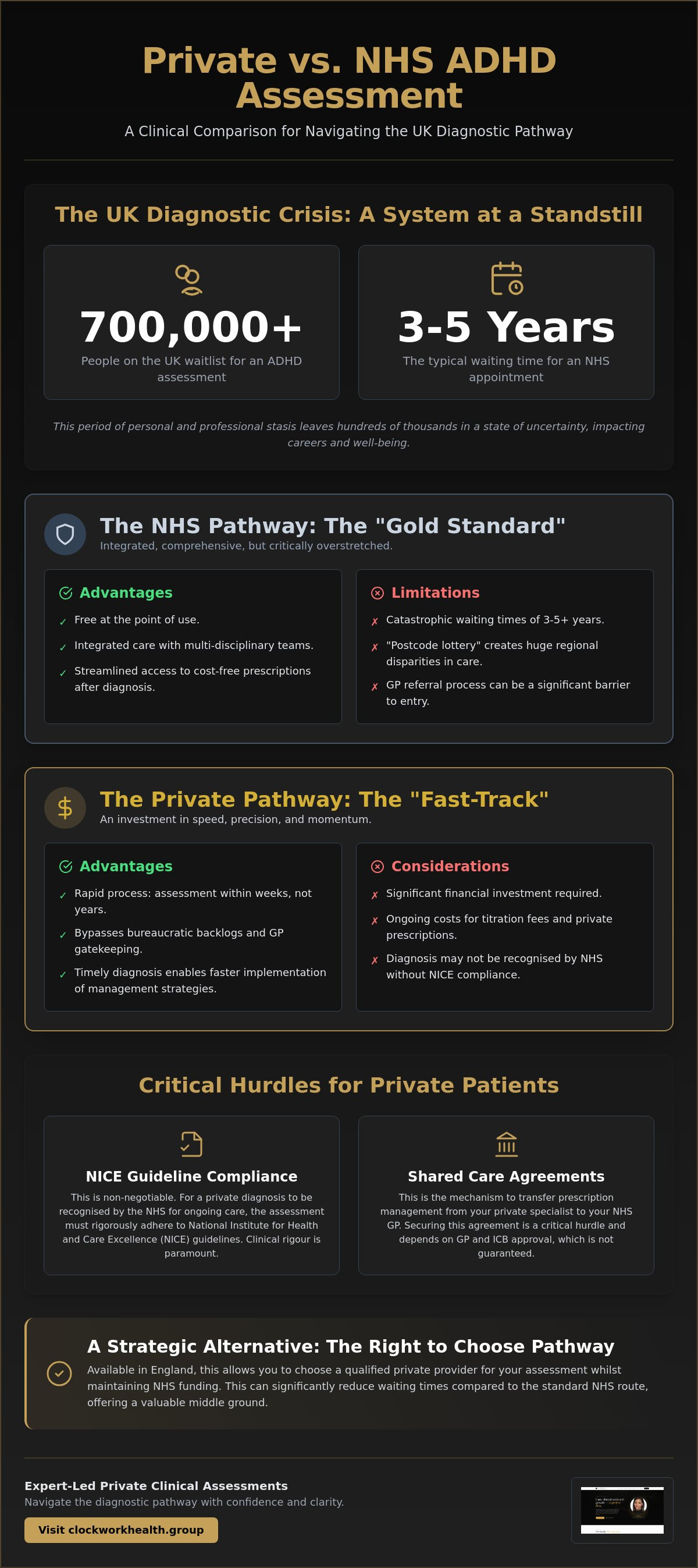
With over 700,000 people currently on the UK waitlist for an ADHD assessment, the system isn't just strained. It's stalled. You're likely facing a three to five year wait for an NHS appointment. This is a period of professional and personal stasis that many cannot afford. Deciding on a private vs NHS ADHD assessment has become a high-stakes calculation. It's about time. It's about precision. You need to know if the speed of the private sector justifies the logistical hurdles of long term care.
We understand the anxiety surrounding medication costs and the validity of Shared Care Agreements. You need a roadmap. This article provides a clinical-first comparison of waiting times, private titration fees, and the regulatory standards required for NHS integration. We'll examine the 2026 landscape of the Right to Choose pathway and the specific steps needed to secure a recognised diagnosis. We'll cover the costs, the risks, and the clinical requirements. This is your guide to navigating the UK diagnostic pathway with confidence and clarity.
Key Takeaways
- Understand the stark disparity in access. Compare the three to five year NHS waitlist against the rapid turnaround of private clinics to make an informed decision.
- Calculate the total investment of private care. You'll need to account for titration fees and medication costs before a Shared Care Agreement can be established.
- Evaluate the strategic trade-offs of a private vs NHS ADHD assessment to determine which route aligns with your clinical needs and financial capacity.
- Explore the Right to Choose mechanism in England. This pathway can significantly reduce waiting times whilst maintaining NHS funding for your treatment.
- Ensure your assessment meets NICE guidelines. Clinical rigour is non-negotiable if you want your private diagnosis to be recognised by the wider healthcare system.
The UK ADHD Diagnostic Crisis: Why the Private vs NHS Debate Matters
The UK diagnostic landscape has reached a critical juncture. For many, the choice between a private vs NHS ADHD assessment isn't just a matter of preference. It's a matter of clinical necessity. Attention deficit hyperactivity disorder (ADHD) is a complex neurodevelopmental condition. It requires precise identification. Yet, the system designed to provide this identification is buckling. Demand has outstripped capacity. The result is a diagnostic bottleneck that leaves hundreds of thousands in professional and personal limbo.
In 2026, we see two distinct pathways. The NHS remains the traditional "Gold Standard" due to its integrated care and cost-free prescriptions. However, the barriers to entry are now insurmountable for many. Conversely, the private "Fast-Track" route offers rapid intervention. It requires significant financial planning. Choosing the right path requires a clinical-first mindset. You must weigh the immediate investment against the long-term risk of remaining in stasis. Precision is the priority. Every month spent waiting is a month of lost productivity and mounting stress.
The Reality of NHS Waiting Times
Wait times have become the defining crisis of British neurodiversity. There are currently over 700,000 people on the UK waitlist. National averages now span between three and five years. In specific regions, lists have ballooned to exceed a decade. This postcode lottery creates a tiered system of care. If you live in a high-demand urban centre, your access to support is effectively frozen. For neurodivergent entrepreneurs, these delays are catastrophic. Stalling a diagnosis directly impacts care business operational efficiency. You cannot optimise a business when the primary strategist is functioning without clinical support. The system is failing to keep pace with the modern workforce.
The Clinical Significance of a Timely Diagnosis
A diagnosis is more than a label. It's a clinical tool for stabilisation. Masking symptoms for years leads to chronic burnout. It erodes workplace performance. It strains personal relationships. By 2026, the shift towards hybrid models has accelerated. Patients are increasingly using private assessments to bypass the initial backlog whilst intending to transition back to NHS primary care. This strategy requires extreme precision. Without a NICE-compliant assessment, the transition often fails. The professional cost of waiting is high. The clinical cost of an unrecognised diagnosis is higher. A timely diagnosis allows for the implementation of structured management strategies. It prevents the compounding effects of untreated neurodivergence. Clarity is the first step toward growth.
Comparing the Pathways: Speed, Cost, and Clinical Rigour
Deciding on a private vs NHS ADHD assessment requires a cold analysis of three variables: speed, solvency, and standards. The choice is rarely binary. It is a strategic calculation. You are weighing the immediate financial investment of private care against the long term professional cost of NHS delays. Every month spent in a diagnostic queue is a month of unmanaged symptoms. Clarity is the objective. Precision is the requirement. You must choose the pathway that offers the highest clinical integrity within your specific timeframe.
The NHS Route: Process and Limitations
The official NHS diagnostic pathway begins at the primary care level. Your GP acts as the gatekeeper. They evaluate your history against local Integrated Care Board (ICB) criteria. If you meet the threshold, you are referred to a multi-disciplinary team (MDT). This team typically includes psychiatrists, specialist nurses, and occupational therapists. The benefits are clear. The service is free at the point of use. Medication access is streamlined. However, the system is overstretched. National averages now suggest a three to five year wait. You are trading years of potential progress for a cost-free diagnosis. For many, this is a trade-off they can no longer afford to make.
The Private Route: What Your Money Actually Buys
Private care is an investment in momentum. It bypasses the bureaucratic backlog. Assessments often move from initial enquiry to clinical conclusion within weeks. You gain the ability to choose your clinician. You control the pace of your titration. High-quality private providers utilise gold-standard tools like the ADOS-2 and structured clinical interviews. This ensures the diagnostic output is robust enough to withstand scrutiny. The trade-off is the upfront cost. You are paying for clinical expertise and administrative efficiency. If you need a private vs NHS ADHD assessment to maintain your career trajectory, the private route offers the fastest return on investment.
NICE Compliance: The Invisible Quality Threshold
Not all private reports are equal. Clinical rigour is defined by the National Institute for Health and Care Excellence (NICE). A compliant assessment must include a full developmental history and observer reports from third parties. It cannot be a brief tick-box exercise. If an assessment lacks these components, your GP will likely refuse to recognise it. NICE compliance serves as the bridge between private diagnosis and NHS medication. Without this standard, your private investment leads to a clinical dead end. If you are seeking a gold-standard evaluation, explore our private ADHD assessments led by registered clinical experts.
The "Right to Choose" (RTC) pathway exists as a statutory third option for patients in England. It allows you to select a private provider whilst the NHS covers the cost. It is a powerful mechanism for reducing wait times. However, by 2026, many ICBs have paused new RTC referrals due to budget constraints. You must verify the current status of RTC in your specific region before proceeding. Success in this pathway requires a GP who is willing to navigate the administrative burden on your behalf.
The Shared Care Agreement: The Critical Hurdle for Private Patients
The Shared Care Agreement (SCA) is the pivot point of the private vs NHS ADHD assessment debate. It is a formal contract of trust. Under this arrangement, a private specialist retains clinical responsibility for your diagnosis whilst your NHS GP takes over the monthly prescribing. This transition is not automatic. It is a discretionary act. In 2026, the SCA has become the most significant hurdle for patients seeking to bypass NHS waitlists. Without it, the financial burden of treatment remains entirely on the individual.
GPs are increasingly hesitant to sign these agreements. The reasons are clinical and regulatory. Many primary care practices are under directive from their Integrated Care Boards (ICBs) to scrutinise private reports for NICE compliance. If an assessment lacks a robust developmental history or fails to include multi-informant evidence, the GP may refuse to prescribe. This creates a "diagnostic trap." You have the label, but you cannot access the affordable treatment that should follow. Success depends on the clinical authority of your original assessment. A report from a CQC-regulated clinic carries weight. A cursory online screening does not.
The financial implications are stark. An NHS prescription in England costs a flat rate of £9.90 per item. In contrast, private medication costs can range from £100 to £250 per month. Over a year, this difference is substantial. Precision in the initial diagnostic stage is your best defence against these ongoing costs. You are not just paying for a diagnosis. You are paying for a clinical document that is robust enough to be integrated into the NHS system. High-quality reports reduce the GP's perceived risk.
Navigating GP Refusal and Medication Costs
If your GP refuses a Shared Care Agreement, you have limited options. You can pay for private prescriptions indefinitely. You can request a second opinion from another GP within the same practice. Or, you can re-enter the NHS waitlist to have your private diagnosis "validated" by an NHS consultant. This last option is a frustrating redundancy. To avoid this, vet your private provider before booking. Ask for their specific SCA success rate. Ensure their clinicians are recognised by the General Medical Council (GMC) or the Nursing and Midwifery Council (NMC). Evidence of clinical rigour is your primary leverage.
Titration: The Bridge Between Diagnosis and Stability
Stability is the prerequisite for shared care. The titration phase is the clinical process of finding your optimal medication dosage. This typically lasts three to six months. During this window, the NHS will not take over prescribing. You must remain under the care of your private specialist. They will monitor your heart rate, blood pressure, and symptom response. Specialist nurses often lead this phase, providing the granular oversight needed for safety. Only once you are on a stable, effective dose can the SCA be proposed. It is a methodical progression. Skipping steps leads to clinical rejection.
The Strategic Choice: When to Go Private vs When to Wait
Choosing between a private vs NHS ADHD assessment is a decision of strategic resource allocation. It is not merely about preference. It is about your professional timeline and clinical safety. For many, the choice is dictated by the severity of their symptoms and the stability of their current environment. If you are in a period of relative calm, the NHS waitlist may be a viable, cost-effective option. However, if your neurodivergence is actively compromising your career or mental health, waiting several years is a high-risk strategy. You must audit your urgency before committing to a path.
Entrepreneurs and care sector leaders often favour the private route for its predictability. In a high-stakes business environment, uncertainty is a liability. A private assessment provides a definitive clinical output within a fixed timeframe. This allows for rapid stabilisation and the implementation of workplace adjustments. Maintaining clinical continuity is the goal. You need a diagnostic report that doesn't just sit in a drawer. It must be a living clinical document that your GP can eventually integrate into your long-term NHS record.
Is the Private Route Right for You?
The private pathway requires a clear financial roadmap. You aren't just paying for the initial appointment. You are investing in a multi-stage clinical process. Before booking, use this checklist to assess your readiness:
- Do you have the budget for the assessment, titration, and at least six months of private prescriptions?
- Is your chosen clinic CQC-regulated and led by registered clinical experts?
- Does the provider have a documented history of successful Shared Care transitions?
- Are you prepared for the possibility of a GP refusal, requiring ongoing private funding?
For neurodivergent founders, a timely diagnosis can be a prerequisite for leadership growth. It often provides the clarity needed when seeking CQC registration support UK for new ventures. Understanding your cognitive profile allows you to build operational systems that work with your brain, not against it. If you are ready to secure a gold-standard diagnosis, explore our private ADHD assessments to regain control of your professional trajectory.
The "Right to Choose" (RTC) Explained
The "Right to Choose" pathway serves as a statutory middle ground. It is a legal mechanism in England that allows patients to choose a private provider for their mental health care while the NHS covers the cost. It combines private sector speed with public sector funding. When it works, it is the most efficient route available. You get a NICE-compliant assessment without the multi-year wait or the four-figure fee. However, the system is under immense strain. By 2026, many Integrated Care Boards have paused new RTC referrals to manage budgets. Waiting lists for popular RTC providers have also grown, sometimes exceeding 12 to 18 months. It is faster than the standard NHS route, but it is no longer the "instant" fix it once was.
Clockwork Health Group: Expert-Led Private Clinical Assessments
Clockwork Health Group operates at the intersection of clinical rigour and operational efficiency. We understand the high stakes involved in a private vs NHS ADHD assessment. Our clinical pedigree is established. Led by Nicola Simms, a Registered Mental Health Nurse, our approach is methodical. We act as the authoritative architect of your diagnostic journey. This means every assessment is designed with the end goal in mind: a stable, recognised diagnosis that supports your professional growth. We bridge the gap between complex healthcare regulation and the practical needs of business leaders.
Precision is our standard. We don't just provide a label. We provide a foundation. Our assessments are built to be NICE-compliant from the outset. This is the only way to ensure your diagnosis carries weight with an NHS GP. We synchronise clinical expertise with an understanding of the care sector's unique pressures. This dual perspective ensures your pathway is both clinically sound and professionally relevant. We remove the friction from the diagnostic process. You receive a report that is robust, detailed, and ready for integration into your long-term care plan.
Clinical Excellence in ADHD Assessment
Our diagnostic framework utilises gold-standard tools. We employ the ADOS-2 amongst other expert-led methodologies to ensure a comprehensive evaluation of your neurodevelopmental profile. We focus on patient-first care. Synchronization is key. Your assessment isn't an isolated event. It is the starting point for long-term stability. Our reports provide the granular detail required for future Shared Care Agreements. We eliminate the ambiguity that often leads to GP refusal. By adhering to the highest professional standards, we protect your investment in your health.
Beyond the Diagnosis
We support care sector entrepreneurs in navigating their own neurodiversity. Being a leader with ADHD requires specific strategies. Our business tools are designed to assist. We offer AI receptionists to manage administrative load. This allows neurodivergent founders to focus on strategic scaling whilst we handle the operational noise. We integrate clinical care with business support. It's a holistic system. If you are ready to move beyond the waitlist, Book a Private ADHD Assessment with Clockwork Health Group today. We provide the clarity you need to lead with confidence.
Securing Your Clinical Future
Navigating the private vs NHS ADHD assessment landscape is a strategic exercise in risk management. You must balance the immediate requirement for clinical clarity against the long term logistical hurdles of the UK healthcare system. We've explored the necessity of NICE compliance and the critical role of Shared Care Agreements in maintaining financial stability. A diagnosis is only as valuable as its recognition by the wider medical community. Precision is the only path to long term success.
Clockwork Health Group provides the architectural precision needed for a successful diagnostic outcome. Our service is led by Nicola Simms, a Registered Mental Health Nurse and ADOS-2 Assessor. We maintain CQC-aligned clinical standards across our national UK coverage. This ensures your assessment is robust enough for NHS integration. Don't let a stalled system dictate your professional momentum. Enquire about a Private ADHD Assessment with our clinical experts to begin your journey toward stability. You have the power to move beyond the waitlist and reclaim your focus.
Frequently Asked Questions
Can I get an ADHD diagnosis privately and then get medication on the NHS?
Yes, you can transition to NHS medication through a Shared Care Agreement (SCA), but it's not a guaranteed right. Your GP must first agree to the arrangement after you've completed a private titration phase and reached a stable dosage. If the GP refuses the agreement, you'll remain responsible for the full cost of private prescriptions. Success in this private vs NHS ADHD assessment transition depends heavily on the clinical rigour of your initial diagnostic report.
How much does a private ADHD assessment cost in the UK in 2026?
The cost of a private assessment depends on the clinician's seniority and the complexity of the diagnostic tools used. You're typically paying for the specialist's time, the administration of validated frameworks, and the production of a NICE-compliant clinical report. Some providers offer a flat fee for the assessment, whilst others charge separately for follow-up consultations. It's essential to verify whether the price includes the administration of observer reports and developmental histories required for NHS recognition.
What happens if my GP refuses to accept a private ADHD diagnosis?
If your GP refuses to recognise your diagnosis, you have three primary options. You can pay for private prescriptions and reviews indefinitely, or you can seek a second opinion from another GP within the same practice. Alternatively, you can ask for an NHS referral to have your private diagnosis validated by an NHS consultant. This often requires joining the standard national waitlist, which currently averages three to five years in most regions.
Will a private ADHD assessment be recognised by my employer or university?
Employers and universities recognise private assessments provided they are NICE-compliant and conducted by a regulated clinician. A robust diagnostic report provides the legal evidence required for "reasonable adjustments" under the Equality Act 2010. You should ensure your provider is CQC-registered. This registration adds the necessary clinical authority to your documentation when presenting it to HR departments or university disability support services.
What is the "Right to Choose" and how does it differ from a private assessment?
Right to Choose (RTC) is a legal mechanism in England that allows you to select a private provider for NHS-funded mental health care. It differs from a standard private assessment because the NHS covers the financial cost of the appointment. In contrast, a private assessment is entirely self-funded by the patient. By 2026, many RTC pathways have significant waiting lists or temporary pauses due to the unprecedented volume of referrals.
Do I need a GP referral to book a private ADHD assessment?
You don't strictly need a GP referral to book a private assessment, as most clinics allow for self-referral. However, involving your GP from the beginning is a strategic advantage. It creates a clinical trail that can simplify the eventual request for a Shared Care Agreement. A GP who has been informed of your intent to seek a private assessment is often more willing to support your long-term medication management.
Is an ADOS-2 assessment necessary for an ADHD diagnosis?
The ADOS-2 is primarily a diagnostic tool for autism, though it's frequently used in high-quality neurodevelopmental clinics to rule out co-occurring conditions. For a standalone ADHD diagnosis, clinicians typically focus on structured interviews like the DIVA-5 and developmental history reviews. Using comprehensive tools ensures your private vs NHS ADHD assessment meets the highest clinical standards. This rigour is what ultimately makes a diagnosis "NHS-ready."
What is titration and why is it so expensive in the private sector?
Titration is the methodical process of adjusting medication doses to find the most effective level with the fewest side effects. It's expensive in the private sector because it requires multiple follow-up consultations with a specialist to monitor your physical health. Additionally, private patients must pay the full market price for medication, which can range from £100 to £250 per month. These costs continue until you achieve clinical stability.