
Care Agency Business Plan UK: A Strategic Template for 2026 Success
A business plan that focuses solely on profit is the fastest way to fail a CQC inspection. Developing a robust care agency business plan UK is no longer just about financial forecasting; it is your primary evidence of fitness to practise. In a landscape where the CQC is transitioning to sector-specific assessment frameworks by the end of 2026, a generic document will not protect your investment. You likely feel the weight of the £1,522 registration fee and the complexity of articulating clinical safety within a commercial context.
We agree that navigating these bureaucratic hurdles while managing the £12.71 per hour National Living Wage is a significant challenge for any new provider. This article provides a professional framework designed to secure CQC approval and drive sustainable growth. We will examine how to build a robust roadmap for recruitment, win local authority tenders, and align your operations with the new regulatory standards arriving later this year. Each section serves as a gear in your operational machine, ensuring your agency moves with precision from day one.
Key Takeaways
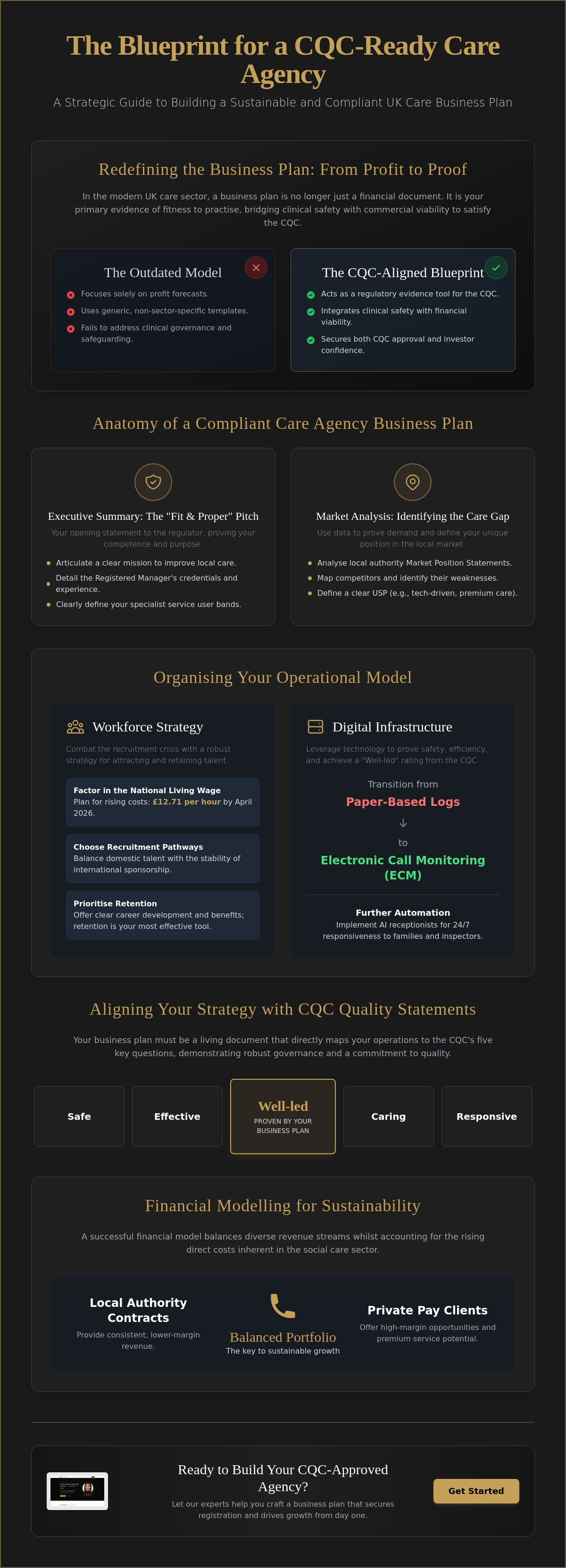
- Redefine your care agency business plan UK as a regulatory evidence tool that bridges clinical safety with financial viability to secure both CQC approval and investor confidence.
- Discover how to navigate the 2026 recruitment crisis by integrating digital transformation tools, moving from paper-based logs to efficient Electronic Call Monitoring.
- Learn to map your operational strategy directly to the CQC’s five key questions, proving a "Well-led" status through robust governance and oversight structures.
- Master financial modelling for the social care sector by balancing high-margin private pay clients with local authority contracts whilst accounting for rising direct costs.
- Understand the critical path from CQC application to winning tenders, including how a professional digital presence acts as your agency's primary storefront.
The anatomy of a care agency business plan in the UK
A care agency business plan UK is a strategic blueprint. It aligns clinical safety, regulatory compliance, and financial sustainability into a single, cohesive document. This is not a static file. It is a live engine for your business. It serves a dual purpose. It satisfies CQC inspectors that your leadership is competent whilst securing investor or bank confidence through data-driven forecasting. Precision is mandatory. In a sector where lives are at stake, your plan must reflect a deep understanding of clinical governance.
Many new providers confuse the Statement of Purpose (SOP) with the overarching business plan. This is a critical error. The SOP is a specific regulatory requirement that defines the services you are legally registered to provide. The business plan is the strategic "how." It covers marketing, recruitment, and long-term scaling. Generic templates fail because they lack care-specific risk assessments. They often ignore the complexities of safeguarding and professional boundaries. Your plan must be bespoke. It should bridge the gap between healthcare standards and entrepreneurial growth.
Executive summary: The "Fit and Proper" pitch
Your executive summary is more than an introduction. It is your "Fit and Proper" pitch to the regulator. Articulate your mission with clarity. Why does your agency exist in a saturated market? You must prove that your entry improves local care quality. The Registered Manager’s credentials are a core business asset. Detail their clinical experience and leadership history. This person is the pivot point of your registration. Clearly define your service user bands. Whether you specialise in dementia, physical disabilities, or complex learning needs, your summary must show you have the expertise to manage those specific risks.
Market analysis: Identifying the UK care gap
Data drives sustainability. Analyse local authority Market Position Statements to prove demand. These reports are essential. They show exactly where care gaps exist in your specific region. An overview of social care in England demonstrates a system that is increasingly reliant on private innovation to meet rising demand. Competitor mapping is your next step. Identify "Good" and "Outstanding" providers in your postcode. Don't just list them. Analyse their weaknesses. Define your USP based on these findings. Are you offering tech-driven care with real-time family portals? Or are you focusing on high-margin, premium private pay? Your market analysis must prove that your agency is the missing piece of the local healthcare puzzle.
Organising your operational model: Staffing, technology, and AI
Operational efficiency is the heartbeat of a sustainable care agency business plan UK. You aren't just building a service; you're engineering a system. In 2026, manual processes are a regulatory risk. Inspectors want to see how you leverage technology to maintain safety and oversight. This begins with your workforce strategy. It ends with a digital infrastructure that operates like clockwork. A modern care agency business plan UK must bridge the gap between traditional care values and high-tech operational standards.
The workforce strategy
The social care sector faces a persistent recruitment crisis. By April 2026, the National Living Wage will rise to £12.71 per hour for those aged 21 and over. Your financial modelling must absorb these costs whilst maintaining service quality. Recruitment pathways are now bifurcated. You must choose between domestic talent and international sponsorship. International routes offer stability but require rigorous compliance with Home Office regulations. Domestic recruitment requires a focus on "care for the carers." Offer clear professional development. Use competitive benefits. Ensure every staff member completes the Care Certificate as a baseline before their first lone-working shift. Retention is your most effective recruitment tool.
Digital infrastructure and automation
Digital transformation is no longer optional. Moving from paper-based logs to Electronic Call Monitoring (ECM) is essential for CQC "Well-led" ratings. It provides real-time data signals. It proves your staff are where they should be. Beyond ECM, modern agencies use automation to handle the administrative burden. Implementing AI receptionists ensures 24/7 responsiveness. Families and inspectors never reach a voicemail. These systems triage calls and handle initial enquiries with clinical precision. This ensures your agency remains responsive even during out-of-hours periods.
Managing a care business involves heavy admin. Using virtual assistants for care businesses allows your Registered Manager to focus on clinical oversight rather than rota scheduling or payroll. These professionals manage compliance scheduling and document control from a remote environment. Whilst you follow the standard UK government business registration steps, your digital infrastructure must be robust. Cyber security and GDPR are paramount. Protecting sensitive patient data in a digital-first agency is a non-negotiable requirement for CQC approval. If you want to scale effectively, optimising your back-office with specialised support is a logical strategic move.
Aligning your strategy with CQC Quality Statements and regulations
Your care agency business plan UK is your primary evidence of "Fitness to Practice." It must mirror the CQC's assessment framework with clinical precision. By late 2026, the regulator will transition from the Single Assessment Framework to four new sector-specific frameworks. The existing 34 Quality Statements will be substituted with new Key Lines of Enquiry (KLOEs) and detailed "Rating Characteristics." Your document must anticipate this shift. Map every operational process to the five key questions: Safe, Effective, Caring, Responsive, and Well-led. The regulator uses these categories to assess your readiness. Precision here is mandatory. If your plan doesn't explicitly mention these upcoming standards, it may be deemed insufficient during the initial assessment phase.
Governance is the backbone of the "Well-led" question. Your plan should detail exactly how you maintain oversight. This includes your reporting structure, clinical audits, and digital data signals. During the Registered Manager interview, the inspector will use your business plan as a baseline for questioning. You must explain how strategic goals align with clinical safety. Seeking professional CQC Registration Support reduces the risk of registration rejection. For detailed steps, consult the official CQC Guidance on Provider Registration. A well-constructed plan proves that you aren't just starting a business; you're building a safe clinical environment that prioritises service user outcomes.
Clinical governance and safety
Incident reporting is a culture, not just a form. Your plan must outline clear protocols for the "Duty of Candour." This ensures transparency and honesty when things go wrong. Safeguarding frameworks must be ironclad. Detail how you protect vulnerable adults from neglect or abuse. Medicines management is critical. Prove your agency can handle complex clinical needs safely through double-check systems and regular competency assessments. These protocols show the CQC that safety is hard-wired into your operations. You must demonstrate that your staff understand their role in the wider safeguarding ecosystem.
The Quality Assurance (QA) cycle
Auditing is your internal pulse check. Set a monthly schedule to monitor service quality across all Evidence Categories. Don't just tick boxes. Integrate the "voice of the person" by using service user feedback to drive your business growth strategy. This turns CQC Quality Statements into actionable business KPIs. Continuous improvement ensures your agency moves from "Good" to "Outstanding" whilst remaining compliant with the latest 2026 standards. This cycle creates a loop of excellence that satisfies both families and regulators. It proves your agency is a learning organisation that values clinical precision.
Financial forecasting for UK care providers: Modelling for sustainability
Financial viability is a core requirement for CQC registration. Your care agency business plan UK must demonstrate that your business is not just aspirational but fiscally sound. In 2026, generic projections are insufficient. You must account for the specific economic pressures of the UK social care sector. This includes the National Living Wage, which rises to £12.71 per hour in April 2026. Proving sustainability requires a granular analysis of your margins. If your break-even analysis doesn't account for the "real cost of care," your agency risks insolvency before it even scales.
Direct costs extend far beyond basic hourly wages. You must factor in National Insurance contributions, pension auto-enrolment, and travel time. Enhanced DBS checks now cost approximately £48 to £53 per person, including verification fees. Capital expenditure is another critical pillar. This includes your £1,522 CQC application fee and the cost of an office premises that meets regulatory standards. Your digital shopfront is equally vital. Budgeting for high-quality care sector website design ensures you attract premium private pay clients from day one. Most agencies require between 250 and 350 care hours per week to reach a stable break-even point, depending on their overheads and regional location.
Pricing strategies in a competitive market
Revenue streams should be diversified to protect your cash flow. Relying solely on local authority contracts is risky due to lower margins and 30-60 day payment terms. Contrast this with high-margin private pay clients who often pay weekly or fortnightly. Use a tiered pricing model. Charge more for complex clinical needs, such as end-of-life care, compared to standard companionship visits. Research the "Fair Cost of Care" in your specific local authority area. This ensures your rates are competitive yet profitable. Precision in pricing prevents the "race to the bottom" that often compromises safety.
Contingency and risk modelling
The CQC expects to see financial resilience. Maintain a buffer of 3-6 months of operating capital. This ensures you can pay staff even if a major contract payment is delayed. Insurance is non-negotiable. You need robust public liability, employers’ liability, and professional indemnity cover. As you grow, decide when to reinvest. Should you hire more field staff or invest in further automation? If your financial modelling feels overwhelming, seeking professional tender writing and financial strategy support can provide the clarity needed for long-term success. A well-modelled plan is the difference between a struggling agency and a thriving healthcare leader.
Executing the launch: From registration to winning tenders
Submitting your care agency business plan UK is the catalyst for your regulatory journey. Once your application is live, the CQC moves through a structured validation phase. This leads to the assessment and the critical Registered Manager interview. Your business plan acts as your script during this high-stakes meeting. It proves your operational readiness. Whilst you wait for approval, focus on your digital shopfront. A professional website is more than a marketing tool. It's a trust-building asset. Families researching care options in 2026 will judge your clinical competence based on your online presence. Trust is built through precision and professional presentation.
Transitioning from a startup to a growth-oriented provider requires a shift in focus. You must move from individual spot contracts to large-scale framework agreements. This is where many agencies stall. The administrative burden of public procurement is heavy. Utilising professional care sector tender writing services allows you to compete with established providers. It ensures your bids are clinically sound and commercially attractive. Precision at this stage is the difference between a struggling agency and a thriving one. Success in the UK care market is reserved for those who treat their business plan as a live strategic engine.
Winning your first contracts
Local authorities manage their care requirements through procurement portals like ProContract or Due North. Registering on these platforms is your first step toward securing stable revenue. The art of bid writing has evolved. It's no longer just about compliance. You must demonstrate "social value" and innovation. Show how your agency benefits the wider community and reduces the burden on the NHS. For the private pay market, digital marketing and local networking are your primary levers. High-margin clients expect a premium, tech-enabled service that provides real-time updates and clinical excellence.
The Clockwork Health Group advantage
Our CQC registration support UK ensures your care agency business plan UK is inspector-ready from the outset. We don't just provide a document; we build a strategic framework for your entire operation. You can even integrate private Autism and ADHD assessments as complementary service lines to diversify your income and add clinical depth to your brand. This multi-disciplinary approach positions you as a modern healthcare leader. Your next step is simple. Book a consultation with Clockwork Health Group to refine your strategy and ensure your agency operates with total synchronisation from day one.
Strategic precision for your 2026 launch
Success in the UK care sector requires a delicate balance of clinical excellence and entrepreneurial agility. You've seen that a robust care agency business plan UK is your most powerful tool for navigating the 2026 regulatory shift. It serves as your evidence of fitness to practise, your roadmap for digital transformation, and your model for financial sustainability. By integrating AI-driven responsiveness and expert administrative support, you ensure your agency operates with total synchronisation from day one.
Don't leave your CQC registration to chance. Our consultancy is led by a registered Mental Health Nurse; this provides you with the clinical authority required for approval. We offer CQC-ready business plan frameworks and expert tender writing services designed to secure your first contracts. Launch your care agency with professional CQC registration support and build a legacy of outstanding care. Your path to a thriving, compliant business starts with a single, methodical step. We are ready to help you build an agency that stands the test of time.
Frequently Asked Questions
Is a business plan a legal requirement for CQC registration?
Yes, a business plan is a fundamental requirement to prove financial viability and leadership competence during the registration process. Whilst the CQC does not mandate a specific format, you must demonstrate how you will meet Regulation 12 (Safe care and treatment) and the "Well-led" criteria. Failing to provide a detailed care agency business plan UK often leads to an immediate rejection of the provider application.
How long should a care agency business plan be?
A comprehensive care agency business plan usually spans 30 to 50 pages. It must be long enough to cover clinical governance, financial forecasting, and recruitment strategies in granular detail. Focus on high-density information that proves your operational readiness and regulatory understanding to both inspectors and potential investors. Avoid generic filler; every page should add value to your clinical or commercial strategy.
What is the most important section of a care business plan for the CQC?
The Quality Assurance and Governance section is the most critical component for the CQC. Inspectors prioritise how you will monitor service safety and respond to incidents through a robust "Duty of Candour" protocol. You must prove that your agency has a learning culture. This section should detail your auditing schedules and how you integrate service user feedback into continuous improvement cycles.
Can I start a care agency without a background in healthcare?
Yes, you can start a care agency without a clinical background, provided you appoint a qualified Registered Manager. This individual acts as the clinical pivot point for your registration and must satisfy the CQC's "Fit and Proper" person requirements. Your role as the provider remains focused on strategic growth and financial sustainability, whilst the manager handles day-to-day clinical oversight and safety.
How much capital do I need to start a care agency in the UK?
Starting a care agency requires significant initial capital, typically ranging from £20,000 to £50,000 for a small-to-medium startup. This covers the £1,522 CQC application fee, insurance premiums, and initial recruitment costs. You must also maintain 3 to 6 months of operating capital to ensure you can pay staff whilst waiting for local authority or private pay cycles to stabilise and become profitable.
What is the difference between a business plan and a Statement of Purpose?
A business plan is a strategic document focused on growth, marketing, and financial sustainability. In contrast, the Statement of Purpose (SOP) is a legal document that defines exactly what regulated activities you provide and who you provide them to. Whilst they are interconnected, the SOP is a public-facing regulatory requirement, whereas the business plan is your internal operational roadmap for the business.
How do I include AI and automation in my care business plan?
Detail your use of Electronic Call Monitoring (ECM) and AI receptionists within the Operational Model section. Explain how these tools ensure 24/7 responsiveness and protect patient data through robust digital audit trails. Highlighting automation proves to the CQC that your agency is "Well-led" and capable of managing administrative burdens without compromising clinical safety or staff wellbeing through manual error.
Should I focus on private pay or local authority contracts in my plan?
Your care agency business plan UK should ideally model a diversified revenue stream. Local authority contracts provide high volume and stability, whilst private pay clients offer higher margins and faster payment terms. Balancing these two streams protects your cash flow against regional funding cuts or delayed council payments. This approach demonstrates fiscal maturity and long-term resilience to regulators and bank lenders.