AI Receptionist vs Virtual Assistant for Care Homes: The 2026 Efficiency Guide
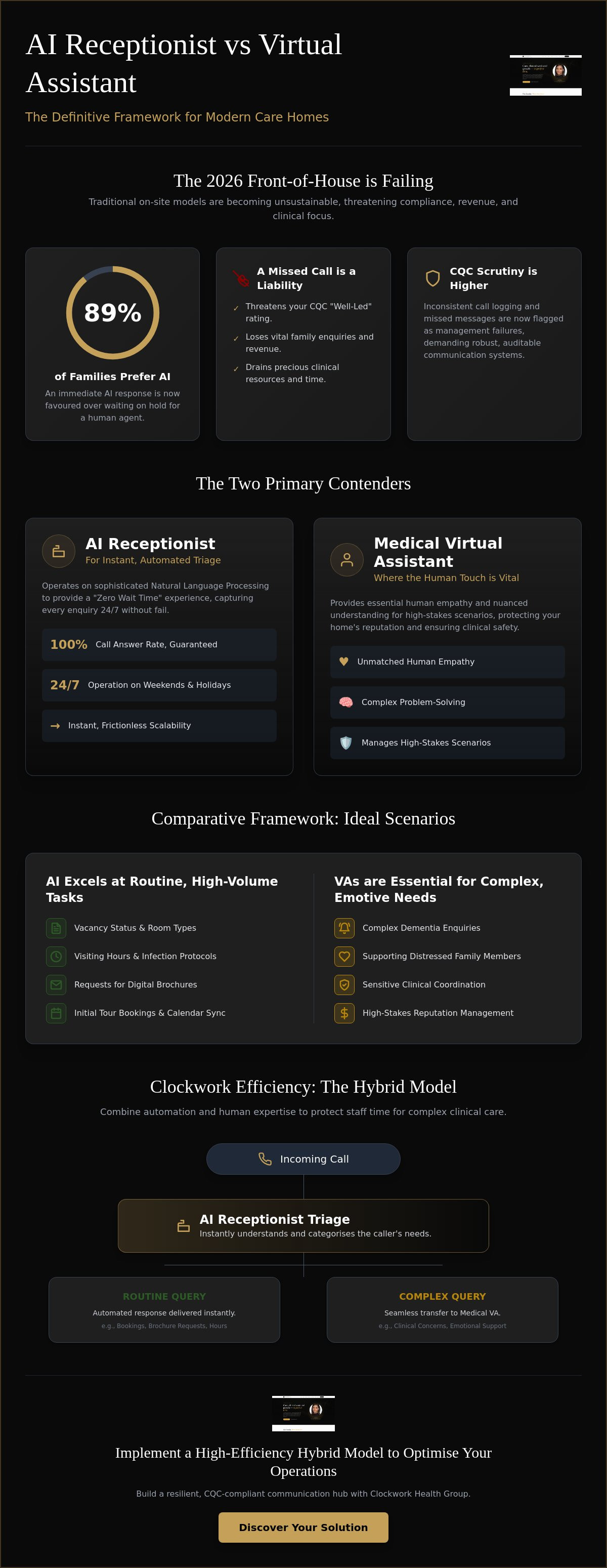
In 2026, a missed phone call is a liability. It threatens your CQC rating; it loses vital enquiries; it drains your clinical resources. With 89% of families now preferring an immediate AI response over waiting on hold, the traditional front-of-house model is obsolete. You likely feel the daily friction of balancing professional call handling with the urgent needs of your residents. Deciding between an AI receptionist vs virtual assistant for care homes is no longer a simple tech choice. It's a strategic move to protect your clinical time and ensure 100% communication compliance.
We understand that your focus belongs on care, not managing telephone queues or fixing inconsistent call logs. This article provides the definitive framework for choosing between AI-driven automation and human virtual support to optimise your operations. We'll compare cost-efficiencies, CQC audit requirements, and the technical integrations needed to eliminate administrative burnout. You'll discover how to reduce overheads while maintaining the professional, reassuring presence your prospective families expect.
Key Takeaways
- Understand why traditional on-site reception models are unsustainable in the 2026 labour market and how to transition to a more resilient hub.
- Master the definitive framework for evaluating an AI receptionist vs virtual assistant for care homes based on operational cost, scalability, and clinical safety.
- Discover how AI-driven voice agents achieve a 100% call answer rate; this secures vital family enquiries during weekends without increasing fixed overheads.
- Identify the high-stakes scenarios, such as complex dementia enquiries, where the human empathy of a medical virtual assistant is essential for reputation.
- Learn to implement a high-efficiency hybrid model that uses automation to filter routine tasks, protecting your staff's time for complex clinical care.
The Evolution of Care Home Front-of-House: AI vs Virtual Support
The care home reception has transformed. It is no longer merely a physical desk; it is a high-stakes hub for clinical coordination and family engagement. In the current climate, every interaction serves two masters: the family and the regulator. Traditional on-site models are failing under the pressure of the 2026 labour market. High turnover and rising costs make 24/7 human coverage prohibitive. Providers can no longer rely on whoever happens to be near the phone.
Strategic providers are now evaluating the AI receptionist vs virtual assistant for care homes as a core business decision. We see two primary contenders: the AI Voice Receptionist and the Medical Virtual Assistant. The Clockwork Health Group philosophy focuses on synchronisation. We believe in building a system where technology and human expertise move in harmony. This approach ensures that your front-of-house operations run with the precision of a well-oiled machine. It is the bridge between clinical excellence and business sustainability.
The 2026 Care Sector Context
Staffing shortages continue to disrupt administrative functions across the UK. When clinical staff are pulled away to handle phones, care quality inevitably drops. Every missed call represents lost occupancy and diminished revenue. It's a risk you can't afford. An AI receptionist acts as a 24/7 digital gatekeeper, ensuring that every enquiry is captured instantly. This technology has progressed far beyond simple automated attendant technology. It now offers sophisticated, natural language interactions that provide immediate value to callers whilst protecting your team's time.
Why "Good Enough" No Longer Passes CQC Scrutiny
Regulatory expectations are higher than ever. The CQC now scrutinises communication systems under the "Well-Led" key line of enquiry. Inconsistent logging or missed messages are flagged as management failures. You must have precise, real-time data to demonstrate safety and responsiveness. Achieving care business operational efficiency is now a fundamental regulatory requirement. Modern front-of-house systems provide the robust audit trails required for inspection. They ensure every family interaction is documented and every lead is tracked. This level of transparency is essential for modern compliance. It proves that your home is organised, methodical, and dedicated to high professional standards. Choosing the right path in the AI receptionist vs virtual assistant for care homes debate is the first step toward this operational harmony.
AI Receptionists: The Case for Instant, Automated Triage
AI voice agents represent a shift in operational precision. They operate on sophisticated Natural Language Processing (NLP) models specifically tuned for the healthcare register. This technology doesn't just route calls; it understands them. For providers weighing up an AI receptionist vs virtual assistant for care homes, the primary advantage is speed. Families in crisis don't want to wait. They need answers now. AI provides a "Zero Wait Time" experience, removing the friction of the traditional switchboard and ensuring no enquiry falls through the cracks during weekends or bank holidays.
The push for digital transformation is global. U.S. Government Reports on AI in Home Care highlight the necessity of innovative solutions to support the caregiving workforce. By adopting these tools, care homes can ensure a professional first impression whilst capturing data the moment a caller engages. Building a digitally resilient care business starts with automating these repetitive touchpoints. AI doesn't sleep. It doesn't take sick leave. It remains a constant, unblinking presence at your digital front door.
Handling Routine Enquiries at Scale
Most care home enquiries follow predictable patterns. AI agents excel at managing these high-volume, routine tasks without fatiguing. They can instantly provide information on:
- Current vacancy status and room types.
- Standard visiting hours and infection control protocols.
- Requests for digital brochures or pricing guides.
- Initial tour bookings and calendar synchronisation.
This automated triage filters non-urgent queries from clinical emergencies. It ensures that when a phone rings on the ward, it's a call that truly requires human intervention. This protection of clinical time is a cornerstone of modern efficiency.
The Consistency of Compliance
Human error is a significant risk in message taking. Details get lost. Names are misspelt. Urgency is misjudged. AI eliminates these variables by transcribing and categorising every interaction instantly. This creates a bulletproof audit trail for CQC inspections. It demonstrates that the provider is "Well-Led" and responsive to enquirers. Every interaction is logged with clinical precision, feeding directly into your care management software. This seamless integration ensures that your records are always current, accurate, and ready for regulatory scrutiny. In the debate of AI receptionist vs virtual assistant for care homes, AI offers a level of data integrity that is difficult to replicate manually at scale.
Medical Virtual Assistants: Where the Human Touch Remains Vital
While automation provides the infrastructure for speed, the human element provides the foundation for trust. In the ongoing comparison of AI receptionist vs virtual assistant for care homes, the virtual assistant (VA) serves as a sophisticated extension of your clinical leadership. These are not generalist call handlers. High-level medical virtual assistant services UK specialise in the intricacies of the care sector. They possess the clinical literacy required to navigate complex enquiries that demand high-stakes judgement and emotional intelligence.
Empathy cannot be programmed. When a family member calls regarding end-of-life care or a sudden dementia crisis, they aren't merely seeking data. They are seeking a partner in their distress. A VA identifies the subtle tremors in a caller's voice; they offer a pause where an AI might offer a prompt. This human connection is the "secret sauce" of high-occupancy care homes. It transforms a cold enquiry into a warm admission. Beyond the phone, these professionals manage the multi-step administrative workflows that keep a facility compliant; they coordinate staff rotas and manage clinical documentation with total precision.
Complex Intake and Family Liaison
First-time care seekers often feel overwhelmed by the bureaucracy of placement. They need a compassionate human voice to guide them through the emotional landscape of social care. A VA acts as a dedicated family liaison, managing the nuances of the intake journey. They don't just book a tour; they prepare the ground. This includes assisting providers with "fit and proper" person interview preparation and ensuring that every family interaction reflects the home's values. It's about building a relationship before the resident even arrives.
Clinical and Administrative Synergy
The role of a medical VA extends deep into the regulatory heart of the business. They provide essential CQC registration support UK by meticulously organising evidence folders and policy documents. In modern multi-disciplinary groups, VAs also coordinate private clinical assessments for ADHD or Autism, ensuring that resident pathways are managed without delay. Their strategic value is further proven in the boardroom. They possess the capacity for complex tender writing and local authority contract management; tasks that require the type of strategic foresight and narrative flair that AI currently lacks. For high-growth providers, the VA is the architect of operational harmony. Choosing the right path in the AI receptionist vs virtual assistant for care homes debate often depends on how much of this high-level synergy your business requires.
Comparative Framework: Cost, Compliance, and Care Quality
The choice between an AI receptionist vs virtual assistant for care homes often rests on the tension between volume and nuance. AI functions as a flat-rate utility. It offers a low fixed cost with high-volume capacity. It scales instantly. You don't need to interview, onboard, or manage a machine. Conversely, a medical virtual assistant provides bespoke value. They represent a higher investment but deliver deeper clinical support. The ROI of AI is found in sheer efficiency; the ROI of a VA is found in complex conversion and clinical coordination.
Managers often fear that families will reject automated interactions. Current 2026 consumer behaviour data refutes this. Enquirers now prioritise speed as a primary indicator of professional standards. Whilst AI wins on data structure and response times, VAs remain the masters of empathy. They handle the "why" and the "how," whereas AI excels at the "what" and the "when." Both tools are essential components of a modern, synchronised front-of-house strategy that protects your clinical margins.
The Decision Matrix for Care Managers
Determining the right balance requires a methodical assessment of your current enquiry profile. Use this checklist to guide your deployment:
- Choose AI if: You receive high volumes of routine brochure requests, visiting hour queries, or out-of-hours leads that require instant triage.
- Choose a VA if: You manage complex dementia intakes, require tender writing support, or need help with staff rota coordination.
- Choose both if: You want 100% call coverage with a human "safety net" for sensitive cases.
Safeguarding is a critical factor here. AI ensures that no safeguarding alert is missed due to a busy switchboard. In a UK context, a single lost private lead can represent over £50,000 in annual revenue. Efficiency is not just about saving money; it's about protecting your home's financial future through rigorous lead management.
Regulatory Perspectives on Automation
The CQC increasingly rewards digital transformation that enhances resident safety and provider responsiveness. Automated systems improve "Safety" by ensuring every message is captured and categorised with total accuracy. There is no room for human error in a digital log. 2026 regulations favour providers with transparent, digital communication logs that prove a well-led organisation. By moving away from paper-based or informal message taking, you demonstrate a commitment to professional standards and regulatory transparency. Optimise your front-of-house operations today by partnering with Clockwork Health Group for a strategic efficiency audit.
Clockwork Efficiency: Implementing the Hybrid Model
Operational harmony is achieved when technology and human expertise move in perfect synchronisation. In the strategic deployment of an AI receptionist vs virtual assistant for care homes, the most resilient providers are opting for a multi-layered architecture. This is the Clockwork Health Group approach. We position AI as the immediate, high-speed filter for all incoming traffic. This ensures every enquiry is answered in seconds. By automating these baseline interactions, the AI effectively "shields" the medical virtual assistant's time. This allows the human professional to focus on high-value clinical admin and complex family liaison without the constant interruption of routine queries.
The transition between these layers must be frictionless. The AI captures the intent, transcribes the dialogue, and flags the priority level. The VA then steps in to execute the nuanced follow-up; this might involve managing the documentation for a private ADHD assessment or finalising a local authority tender. This workflow eliminates the administrative bottleneck that often plagues traditional care homes. It allows your on-site clinical team to remain present for residents. Clockwork Health Group acts as the strategic architect of this integrated system, ensuring every component of your business machine moves with clinical precision.
Setting Up Your Care Machine
Integration is the foundation of this digital ecosystem. Your AI receptionist should be deeply embedded into your digital front door through specialised care sector website design. This ensures that the data flow between the caller, the AI, and your care management software is uninterrupted. You must also focus on customising the AI’s "persona" to match your specific brand voice. It should sound clinical, authoritative, and professional. This attention to detail ensures that the family’s first impression is one of total competence and reliability. It's about creating a unified, professional front from the very first ring.
The Future of Care Administration
The sector is moving toward a new operational standard. We predict the emergence of "Admin-Light" care homes by 2027. In this environment, manual logging and routine call answering are entirely automated. Providers should view these technologies not as a replacement for human care, but as clinical enablement. It is the mechanism that restores time to the ward. By adopting this hybrid framework, you secure your CQC "Well-Led" status and future-proof your margins. The era of fragmented administration is ending. It is time for total synchronisation. Explore our modern business and tech solutions for care providers to begin your transformation.
Achieving Operational Harmony in Modern Care
Navigating the choice between an AI receptionist vs virtual assistant for care homes is the first step toward building a resilient, 2026-ready facility. By integrating automated triage with specialised human support, you eliminate the risks of missed enquiries and administrative burnout. This strategic framework ensures that your clinical staff remain at the bedside whilst your front-of-house maintains 100% responsiveness. It's about precision. It's about safety. It's about ensuring your home remains a leader in a competitive, highly regulated market.
Clockwork Health provides the steady hand you need to manage this transition. As CQC registration experts led by Registered Mental Health Nurses, we understand the high stakes of care delivery. We don't just offer tools; we provide a specialised care sector tech stack designed for total efficiency. Optimise your care home operations with our AI and VA solutions today. Your team deserves the time to focus on what truly matters: providing exceptional care to your residents.
Frequently Asked Questions
Is an AI receptionist CQC compliant for a UK care home?
An AI receptionist is fully CQC compliant when implemented as part of a robust communication strategy. It specifically supports the "Well-Led" key line of enquiry by providing transparent, real-time audit trails of all family and professional interactions. Providers must ensure the system integrates with their existing data protection policies to maintain high standards of digital security and regulatory transparency.
How much does a medical virtual assistant cost compared to on-site staff?
Medical virtual assistants offer significant cost efficiencies by eliminating the overheads associated with on-site reception staff. You avoid expenses such as National Insurance, pension contributions, and office space. Whilst on-site receptionists require a fixed salary regardless of call volume, a virtual assistant model allows for a more flexible, output-based investment that scales with your occupancy levels.
Can an AI receptionist handle emergency safeguarding calls?
AI receptionists are programmed to identify high-priority keywords associated with safeguarding and clinical emergencies. The system immediately routes these critical calls to a designated clinical lead or on-site manager. This ensures that urgent matters bypass routine administrative enquiries, maintaining a high standard of resident safety and immediate regulatory responsiveness.
What is the difference between an AI receptionist and a standard answering service?
The primary difference lies in intelligence and functional integration. A standard answering service typically involves a human taking a static message; an AI receptionist uses Natural Language Processing to understand context and execute specific tasks. It can check vacancies, book tours, and update care records instantly, whereas traditional services remain passive and disconnected from your operational software.
Do families find AI receptionists off-putting in a care setting?
Most families prioritise immediate responsiveness over human interaction for routine queries. In the current market, 89% of enquirers prefer an instant AI response to waiting on hold. The AI receptionist vs virtual assistant for care homes debate shows that families value the professionalism of a system that answers every call without delay, provided the tone remains respectful and clinical.
How long does it take to set up a virtual assistant for a care agency?
Deployment typically takes between one and two weeks depending on the complexity of your workflows. This period includes the systems integration phase and the briefing of the assistant on your specific brand voice. Because these professionals are already sector-specialists, the learning curve is significantly shorter than training new on-site administrative staff from scratch.
Can I use both an AI receptionist and a virtual assistant simultaneously?
A hybrid model is often the most efficient approach for modern providers. Using an AI receptionist vs virtual assistant for care homes simultaneously allows the AI to handle high-volume triage whilst the VA manages complex clinical follow-ups. This synchronisation ensures that your human resources are reserved for tasks requiring high emotional intelligence and clinical judgement.
What technical requirements does my care home need for an AI receptionist?
You primarily need a stable internet connection and a VoIP-compatible telephone system. Most modern AI solutions are cloud-based and integrate directly with existing care management software via API. Your website should also be optimised to host the digital interface, ensuring a seamless journey from the initial online enquiry to the first voice interaction.