
Choosing the Right Path: Healios Private Assessment Alternatives in the UK (2026)
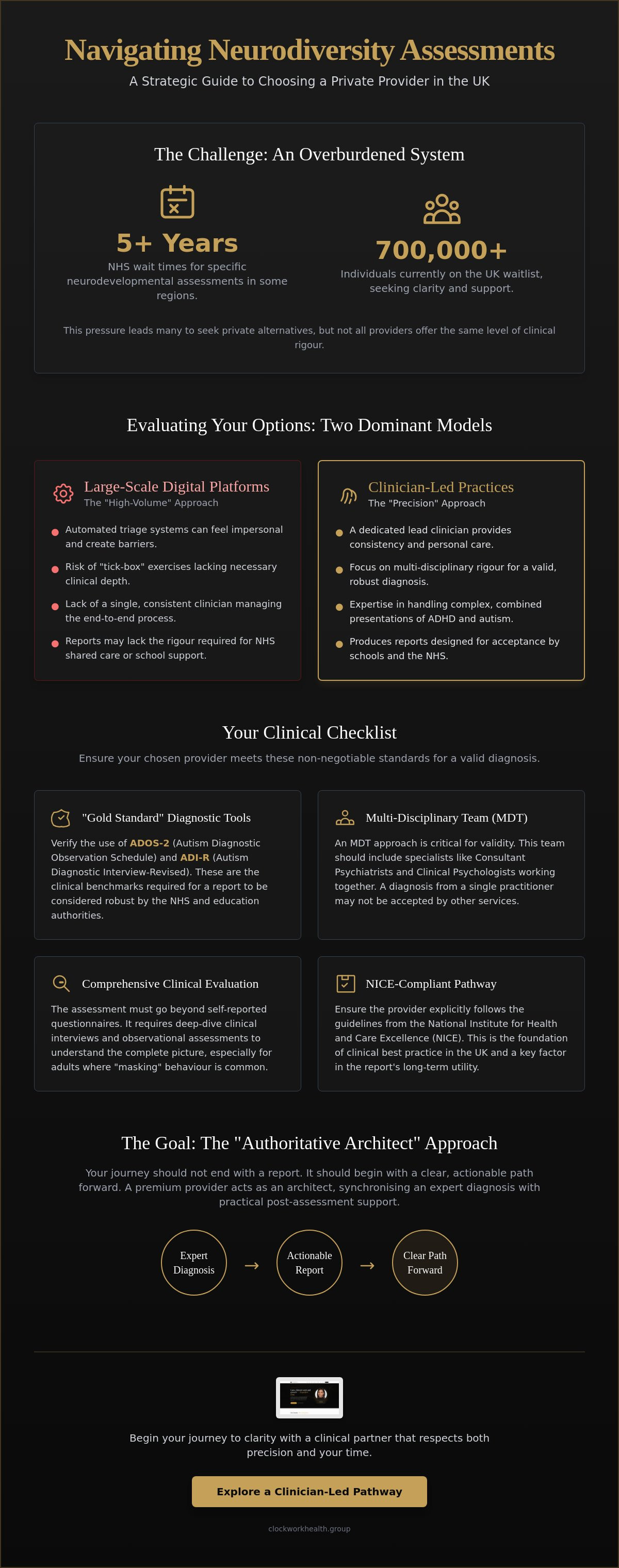
What if the most efficient route to clarity isn't found on a digital waitlist, but through a precision-engineered clinical partnership? You've likely felt the weight of the current system. With NHS wait times now exceeding five years for specific assessments and over 700,000 people on the UK waitlist, the pressure to find a solution is immense. It's common to fear that seeking speed means settling for a "tick-box" exercise that lacks clinical depth or fails to meet the standards required for school support and NHS shared care agreements.
This article identifies the most robust Healios private assessment alternatives for 2026. We'll show you how to evaluate providers based on clinician-led expertise and multi-disciplinary rigour. You'll learn to distinguish between simple screenings and formal, NICE-compliant diagnoses that carry weight. We'll preview the essential criteria for post-assessment support, ensuring your journey doesn't end with a report, but begins with a clear, actionable path forward. Precision matters. Your time matters. Let's find a provider that respects both.
Key Takeaways
- Identify the non-negotiable clinical standards, such as ADOS-2 and ADI-R certifications, to ensure your diagnostic report is robust enough for NHS and school acceptance.
- Evaluate Healios private assessment alternatives by comparing the high-volume digital model against the precision and personal care of clinician-led, boutique practices.
- Understand why a Multi-Disciplinary Team (MDT) approach is critical for the validity of neurodevelopmental diagnoses in the current UK healthcare landscape.
- Learn how to strategically organise your clinical history, including school and workplace observations, to facilitate a thorough and efficient assessment process.
- Discover the value of an "Authoritative Architect" approach that synchronises expert diagnosis with actionable post-assessment support.
Navigating the Neurodiversity Diagnostic Landscape in 2026
The UK private healthcare sector is undergoing a significant transformation. As NHS wait times for ADHD and autism assessments continue to exceed three years in many regions, the private market has expanded to fill the void. However, this growth has led to a divergence in care models. On one side, we see large-scale digital platforms. On the other, smaller, clinician-led practices. This distinction is why many are now evaluating Healios private assessment alternatives. They want a service that balances speed with clinical depth.
Precision is the new currency. In a post-pandemic world, the novelty of "online-only" care has faded. It has been replaced by a demand for rigorous, evidence-based evaluations. Every assessment must meet strict autism diagnostic standards to be considered valid by the NHS or educational bodies. A diagnosis is only as strong as the methodology behind it. Clinician-led practices are reclaiming the "gold standard" by focusing on thorough, multi-disciplinary reviews rather than high-throughput data processing.
The Rise of the Informed Patient
Patient expectations have shifted. Increased digital awareness has created a more discerning audience. They recognise the difference between a cursory screening and a deep clinical dive. They aren't looking for a simple label. They are looking for a comprehensive understanding of their neurotype. This move toward "quality over quantity" defines the current market. 2026 has become the year of the informed patient. People now demand holistic pathways. They value providers who see the person, not just the symptoms.
Common Triggers for Seeking Alternatives
Why do individuals pivot away from large providers? The reasons are often pragmatic. Automated triage systems can feel like a barrier rather than a bridge. Many patients find these "factory models" lack the personal touch required for sensitive clinical work. Common triggers include:
- Consistency: The desire for a single, lead clinician to manage the end-to-end process.
- Complexity: Seeking specialists who can untangle combined presentations of ADHD and autism.
- Acceptance: Ensuring reports are robust enough to secure school support or workplace adjustments.
Choosing Healios private assessment alternatives allows for a more synchronised experience. It bridges the gap between clinical expertise and modern efficiency. It's about finding a steady hand in a complex landscape.
Key Criteria for Choosing a Private ADHD or Autism Assessment Provider
Selecting a diagnostic pathway requires more than a search for the shortest waitlist. It demands a strategic evaluation of clinical integrity. For many seeking Healios private assessment alternatives, the primary goal is a report that stands up to scrutiny from both the NHS and local education authorities. A diagnosis is a permanent medical record. It must be built on a foundation of recognised standards and multi-disciplinary expertise. Speed is valuable, but validity is vital.
Clinical credentials are the first metric. You should verify that your provider utilises the Autism Diagnostic Observation Schedule (ADOS-2) and the Autism Diagnostic Interview-Revised (ADI-R). These tools are the benchmark for valid results. Without them, private reports are frequently dismissed by NHS GPs during shared care negotiations. Consistency in methodology ensures that your investment provides long-term utility across all sectors of the UK care system.
Clinical Robustness: Beyond the Screening Call
A robust assessment is not a "tick-box" exercise. It must involve a comprehensive clinical and psychosocial evaluation. This is a core requirement of the NICE guidelines for ADHD and autism. Observational assessment is particularly critical for adults, where masking behaviour often complicates the diagnostic picture. If a provider relies solely on self-reported questionnaires without deep-dive clinical interviews, the validity of the outcome is compromised. Quality takes time. Precision requires focus.
The Multi-Disciplinary Team (MDT) Explained
The "gold standard" for neurodevelopmental diagnosis is the Multi-Disciplinary Team. This panel typically includes Consultant Psychiatrists, Clinical Psychologists, and Specialist Nurses. A single-clinician approach is often insufficient. Local authorities and NHS trusts look for the collective consensus that an MDT provides. It reduces bias. It increases accuracy. It ensures every angle of a patient's presentation is considered. This level of rigour is a hallmark of high-quality Healios private assessment alternatives.
At Clockwork Health Group, we structure our MDT to mirror the highest levels of clinical governance. This approach synchronises different professional disciplines into a single, efficient diagnostic engine. By choosing a provider with a formal MDT, you ensure your report is "NHS-ready" from day one. You can explore how we organise our clinical pathways to prioritise this level of rigour.
Transparency in pricing is equally vital. Private assessments in the UK represent a significant financial commitment. Hidden fees for follow-up letters or prescriptions can quickly erode your budget. Ensure your quote includes the final diagnostic report and the initial consultation. Post-diagnostic support shouldn't be an afterthought. Ask what happens after the final appointment. A reputable provider offers a roadmap for medication, therapy, or workplace adjustments, rather than leaving you with a report and no direction.
Comparing Large-Scale Digital Platforms with Clinician-Led Practices
The choice between a mass-market digital platform and a clinician-led practice often comes down to the underlying model of care. Large providers frequently operate what is known as a "factory model." This system prioritises high-volume throughput and standardised data collection. Whilst efficient, it can feel impersonal to the patient. In contrast, boutique clinician-led groups focus on a precision-based model. Here, clinical expertise is synchronised with personal care. For those exploring Healios private assessment alternatives, this distinction is fundamental to the diagnostic experience.
Wait times vary significantly across the sector. Digital giants often leverage massive clinician networks to offer appointments within one to six weeks. However, agile private groups can often match this pace without the bureaucratic overhead. The real difference lies in personalisation. In a high-volume environment, your time with a senior consultant may be limited. A clinician-led practice ensures that the expert who reviews your history is the same person who conducts your assessment. This consistency builds trust. It ensures no clinical nuances are lost in transition. Precision requires focus. Focus requires time.
Operational Efficiency vs. Patient Connection
Large platforms use automation to manage high patient volumes. This helps with scheduling but can lead to clinician burnout. High-throughput environments often pressure specialists to move quickly. This risks missing subtle diagnostic markers. A more measured pace is essential for accuracy. Clinician-led practices prioritise the depth of the evaluation over the number of patients seen. The goal is a definitive outcome, not just a completed form. Accuracy is the priority. Throughput is secondary.
The Value of Specialised Business Support
Modern technology shouldn't replace clinical empathy. It should support it. We advocate for the strategic use of tools like AI receptionists. These systems handle administrative tasks with total precision. They ensure your enquiries are managed instantly. This "Clockwork" approach frees up clinicians. They can focus entirely on patient time rather than paperwork. Administrative efficiency and clinical excellence are not mutually exclusive. When synchronised correctly, they create a seamless journey from the first call to the final report. This is how Healios private assessment alternatives are redefining the patient experience in 2026.
Administrative harmony supports clinical success. By automating the routine, we protect the sacred space of the consultation. Patients feel heard. Clinicians feel supported. The result is a diagnostic pathway that feels both modern and deeply human. It's a bridge between traditional healthcare values and contemporary operational efficiency.
Why Clockwork Health Group is a Strategic Alternative for Clinical Excellence
Clockwork Health Group operates as an authoritative architect in the neurodiversity space. We don't just offer assessments. We design pathways that bridge the gap between clinical rigour and modern operational efficiency. For those researching Healios private assessment alternatives, the choice often rests on the balance of speed and substance. We achieve this by synchronising deep-seated healthcare expertise with the precision of a high-growth business. Every component of our process is engineered to provide clarity without the bureaucratic friction common in larger platforms.
Our approach is methodical. We understand the wider care sector ecosystem because we are active participants in it. This perspective allows us to anticipate the requirements of schools, employers, and the NHS. We ensure your diagnostic report is not just a document, but a functional tool for future support. By choosing a provider that understands the regulatory landscape, you secure a diagnosis that carries genuine weight across the UK healthcare system.
Clinician-Led, Not Corporate-Led
The leadership of Clockwork Health Group is rooted in clinical practice. Nicola Simms, our founder, is a registered Mental Health Nurse and a certified ADOS-2 expert. This clinical foundation dictates every operational decision we make. Unlike corporate-led platforms that prioritise shareholder returns, our primary metric is diagnostic accuracy. We remain committed to the ADOS-2 assessment for both adults and children. This commitment ensures our Healios private assessment alternatives meet the highest possible standards. When a report is signed by a practicing professional with deep regulatory knowledge, its credibility is unquestionable.
The Clockwork Ecosystem
We believe that clinical excellence requires administrative harmony. Our background in care consultancy informs our clinical standards. We use modern technology, such as AI receptionists and virtual assistants, to streamline the diagnostic journey. This isn't about replacing humans. It's about freeing up our clinicians to focus on you. The result is a percussive, efficient process that respects your time and your investment. We remove the "noise" of healthcare administration, leaving only the signal of expert clinical insight.
A diagnosis should be a beginning, not an end. Our strategic approach ensures you leave with a clear roadmap for the future. If you are ready to experience a diagnostic pathway designed with precision and clinical authority, you can book your private assessment with Clockwork Health Group today. We provide the steady hand you need to move forward with confidence.
Preparing for Your Private Assessment: A Roadmap to Clarity
Preparation is the backbone of a successful diagnostic outcome. It ensures the Multi-Disciplinary Team has the data required to make a definitive finding. When evaluating Healios private assessment alternatives, look for providers that guide you through this preparatory phase with precision. A robust diagnosis depends on longitudinal evidence. This means gathering history from multiple sources. You should collect school reports, workplace feedback, and family observations before your first appointment. These documents provide the context that a single interview cannot capture.
The initial consultation is where you set expectations. It's a strategic meeting to define your goals. Are you seeking workplace adjustments? Do you require a pathway to medication? Defining these objectives early ensures the process remains focused. On the assessment day, you will undergo clinical interviews and direct observations. If you are pursuing an autism diagnosis, this will likely include the ADOS-2. It's a methodical, structured session. It's designed to see how you process information and interact in real-time. Reviewing the findings is the final stage of the diagnostic engine. Your report should be detailed, technical, and actionable.
Maximising the Value of Your Consultation
The pre-assessment pack is the foundation of diagnostic success. It organises your history into a format that clinicians can analyse efficiently. During your feedback session, you must ask specific questions to ensure the report meets your needs. Ask how the findings align with Healios private assessment alternatives you may have considered. Query the clinician on the specific evidence used for the diagnosis. You should also ask: "What specific reasonable adjustments will help me perform at my best in my current job role?" A high-quality report acts as a lever. It allows you to secure support under the Equality Act 2010 with total confidence.
Booking Your Pathway
Transitioning from an NHS waiting list to a private pathway is a common strategic move. You don't have to give up your place on the NHS list to seek a private opinion. Most private clinics can offer appointments within one to six weeks. This speed allows you to access support years ahead of the traditional system. At Clockwork Health Group, we synchronise our clinical availability with the needs of our patients. We provide a steady hand to help you navigate the transition with ease. Our process is designed to be percussive and purposeful. We respect your time. We value your investment.
Clarity is within reach. You can organise your clinical assessment with Clockwork Health Group today and take the first step toward a definitive roadmap for your future.
Securing Your Path to Diagnostic Clarity
The diagnostic landscape in 2026 demands a strategic shift from volume to validity. You now have the power to choose a pathway that prioritises clinical depth over high-throughput data processing. By focusing on multi-disciplinary rigour and NICE-compliant standards, you ensure your report carries the weight required for long-term support from the NHS and educational bodies. Finding the right Healios private assessment alternatives is about identifying a clinical partner who respects your time and your unique neurotype. Precision is not optional. It is the foundation of your future support.
Clockwork Health Group provides this steady hand. Led by Nicola Simms, a registered Mental Health Nurse and ADOS-2 assessor, our practice is built on CQC compliance-driven clinical standards. We utilise a comprehensive Multi-Disciplinary Team approach to ensure every diagnosis is robust and evidence-based. Don't settle for a tick-box exercise when you can access precision-engineered care. Our process is designed to be efficient, authoritative, and deeply human.
Secure your private assessment with our clinical experts and move forward with the clarity you deserve. Your journey toward understanding begins with a single, expert-led step. We are ready to help you navigate the complexities of the care system with confidence.
Frequently Asked Questions
Is a private assessment from an alternative provider recognised by the NHS?
NHS services generally recognise diagnostic reports from independent providers that adhere to NICE guidelines. This is supported by the NHS England 2026/27 payment scheme guidance, which encourages the acceptance of private reports to avoid unnecessary reassessments. You must ensure your provider uses a Multi-Disciplinary Team and standardised tools like ADOS-2. Always check with your GP surgery regarding their specific policy on "shared care" medication agreements before booking.
What is the difference between Healios and Clockwork Health Group?
The primary difference lies in the delivery model and scale of the practice. Healios is a large-scale digital platform built for high-volume throughput. Clockwork Health Group is a clinician-led, boutique practice that prioritises a precision-based approach. As one of the leading Healios private assessment alternatives, we ensure a senior clinician manages your journey from the initial history gathering to the final diagnostic outcome. Precision matters more than volume.
How much does a private ADHD and Autism assessment cost in 2026?
In 2026, private ADHD assessments in the UK typically range from £500 to £1,200. The median cost is approximately £950, though prices in London often average around £1,100. Combined ADHD and autism assessments generally cost between £900 and £2,500. It's essential to confirm that your quote includes the final diagnostic report and initial follow-up consultations to avoid unexpected administrative fees later in the process.
Can I use "Right to Choose" with Clockwork Health Group?
We focus on providing private, clinician-led assessments directly to individuals and families who require immediate clarity. Whilst the NHS "Right to Choose" scheme allows patients to select certain qualifying providers, Clockwork Health Group operates as a private diagnostic practice. This ensures we maintain agile wait times and high clinical standards without being subject to the funding limitations that currently affect some NHS Integrated Care Board pathways.
What qualifications should I look for in a private neurodiversity assessor?
You should verify that clinicians are registered with professional bodies such as the NMC or HCPC. Ensure they hold formal certifications in the Autism Diagnostic Observation Schedule (ADOS-2) and the Autism Diagnostic Interview-Revised (ADI-R). A valid assessment requires a Multi-Disciplinary Team approach. This panel should include Consultant Psychiatrists or Clinical Psychologists. This collective expertise ensures the diagnosis meets the "gold standard" required for recognition by schools and employers.
How long is the typical wait time for a private assessment at Clockwork Health Group?
Most private clinics can offer assessment appointments within one to six weeks. At Clockwork Health Group, we synchronise our clinical schedules to maintain these efficient timelines. This is a significant contrast to NHS waiting lists in London, which can now exceed five years. Our streamlined administrative system ensures you move from your initial enquiry to a formal consultation without the bureaucratic delays common in larger organisations.
What happens if my assessment does not result in a diagnosis?
A clinical assessment is a search for clarity, not just a label. If the evidence doesn't meet the formal diagnostic criteria for ADHD or autism, your clinician will explain the findings in detail. They will identify other factors contributing to your presentation. You'll still receive a comprehensive report that outlines these observations. This document is a valuable tool for your GP to refine your ongoing care plan and support.
Do you provide medication titration after an ADHD diagnosis?
We specialise in the diagnostic phase of the neurodiversity pathway. Following a formal diagnosis, we provide a clear roadmap for your next steps. This includes advice on medication pathways and workplace adjustments. Whilst we focus on the assessment itself, our reports are engineered to facilitate shared care agreements with your GP. You should discuss ongoing medication management with a specialist prescriber once your clinical diagnosis is confirmed.